Sales Effectiveness

Nikita Jain
Introduction
Some sales teams continue to improve year after year, while others plateau—even when they sell similar products in comparable markets. In 2026, the performance gap is no longer explained by talent alone or by the amount of training delivered. The real differentiator is how sales coaching is designed and executed.
Traditional coaching approaches—sporadic one-on-ones, deal inspections, and generic feedback—can no longer keep pace with today’s fast-moving, data-rich sales environments. Buyers are more informed, sales cycles are longer, and product and pricing changes are constant. At the same time, sales managers are expected to coach more representatives with less available time. As a result, sales coaching has had to evolve.
Modern sales coaching has shifted from intuition-based conversations to structured, insight-driven, and technology-enabled practices. Coaching is no longer about telling reps what to do after a deal is lost or won. Instead, it focuses on improving how reps think, decide, and execute during real selling moments.
The most effective sales coaching tactics in 2026 are built on precision, consistency, and personalization. High-performing teams use coaching to reinforce the right behaviors at the right time, rather than relying on occasional feedback or post-mortem deal reviews. Coaching is embedded into daily workflows, supported by data, and aligned closely with how reps actually sell.
This shift matters now because coaching is one of the few performance levers that directly improves results without increasing headcount. Teams that modernize their coaching approach consistently see faster ramp times for new reps, stronger execution across complex deals, and greater consistency in performance across the team.
Leading sales organizations are replacing traditional deal-review coaching with targeted, skill-based interventions. Managers are learning how to coach at scale by focusing on patterns, prioritizing high-impact behaviors, and using technology to guide conversations—without burning out themselves or their teams.
This blog explores the most effective sales coaching tactics in 2026, highlighting what top-performing sales teams are doing differently and how sales managers can apply these practices immediately to drive measurable performance gains.
Why Traditional Sales Coaching Falls Short in 2026
Sales coaching in 2026 looks very different from what worked even a few years ago. While the fundamentals of good coaching—clarity, trust, and accountability—remain the same, the environment around sales teams has changed dramatically. Buyers are more informed, sales cycles are less linear, and managers are responsible for larger, more distributed teams. As a result, many traditional coaching approaches no longer deliver the impact they once did.
One of the biggest challenges is time scarcity. Sales managers today juggle forecasting, hiring, deal reviews, internal alignment, and reporting—often leaving coaching as an afterthought. When coaching does happen, it’s rushed, reactive, and focused on immediate deal rescue rather than long-term skill development.
Another major issue is deal-centric coaching. Traditional coaching often revolves around pipeline inspections and deal updates. While this may help short-term forecasting, it rarely improves rep capability. Reps learn how to close this deal, but not how to think better across future deals. Over time, managers become bottlenecks instead of multipliers.
The rise of remote and hybrid selling has also exposed gaps. Without regular in-person interaction, managers struggle to observe selling behaviors directly. Coaching relies on second-hand updates instead of real evidence, making feedback less precise and less credible.
These problems tend to surface in consistent patterns:
Coaching conversations dominated by managers talking
Feedback that is generic or outcome-focused
High performers improving while average reps plateau
Managers stepping into deals instead of coaching skills
Coaching happening only when targets are missed
At this point, sales leaders often ask hard questions.
Why doesn’t more coaching automatically lead to better performance?
Because frequency without focus doesn’t change behavior. Coaching must target specific skills and decisions tied to real selling moments.
Can sales coaching still work when managers have limited time?
Yes—but only when coaching is structured, data-informed, and embedded into daily workflows instead of added on top.
Why do reps resist coaching even when they need it?
Reps resist when coaching feels like inspection or judgment. They engage when coaching helps them win more consistently.
In 2026, effective sales coaching shifts from intuition to insight. Instead of relying on memory or anecdotal examples, managers use data from calls, emails, CRM activity, and practice environments to identify real skill gaps. This allows coaching to be precise rather than generic.
Another key shift is skill-based coaching. Rather than reviewing every deal from scratch, managers focus on one or two skills at a time—discovery depth, objection handling, value articulation, or negotiation discipline. This focus accelerates improvement and reduces cognitive overload for reps.
Modern coaching also emphasizes rep ownership. Instead of prescribing solutions, managers guide reps to analyze their own performance and choose next actions. This builds confidence and reduces long-term dependency.
Organizations that update their coaching approach see clear benefits:
Faster improvement across mid-performing reps
More consistent execution across the sales team
Reduced manager burnout from deal firefighting
Clearer linkage between coaching and revenue outcomes
Traditional sales coaching isn’t broken—but it is incomplete. In 2026, teams that continue to rely solely on old models struggle to scale performance. The most effective teams adapt by combining structure, technology, and human judgment.
The Most Effective Sales Coaching Tactics High-Performing Teams Use in 2026
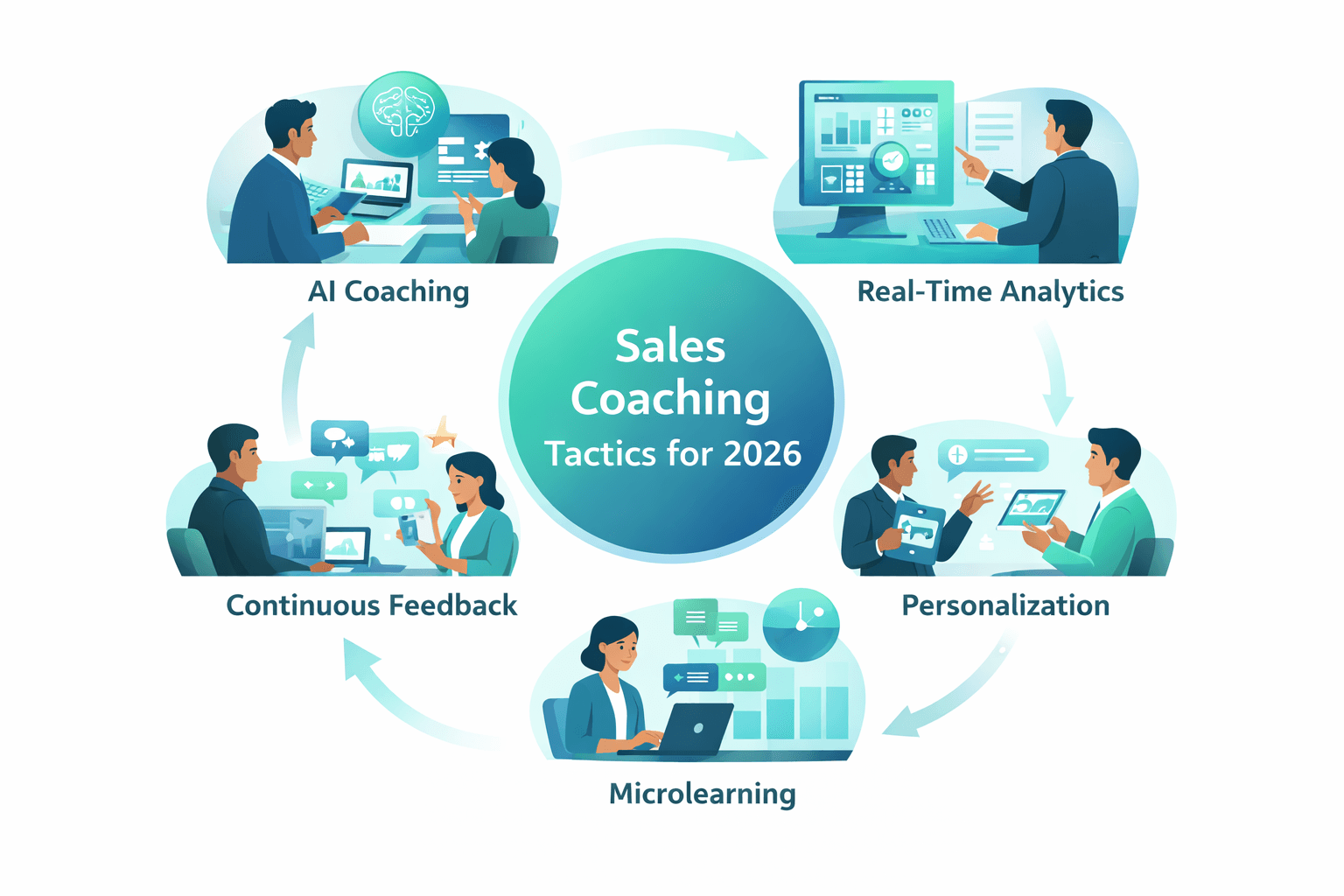
In 2026, the best sales coaching tactics focus on precision, scalability, and behavior change. High-performing teams no longer rely on intuition-heavy coaching or ad-hoc deal reviews. Instead, they use structured approaches that improve specific skills, reinforce learning in real selling moments, and scale across growing teams.
One of the most impactful tactics is skill-based coaching. Rather than reviewing entire deals, managers focus each coaching session on a single skill—such as discovery depth, objection handling, or value articulation. This clarity reduces overwhelm and accelerates improvement. Managers often worry that narrowing focus limits context, but in practice, skill-based coaching improves transfer across multiple deals.
Another key tactic is data-informed coaching. Managers use call recordings, CRM activity, and practice data to ground conversations in evidence. This removes subjectivity and defensiveness from coaching. When reps ask whether data-driven coaching feels intrusive, the reality is that clarity feels fairer than opinion when handled with transparency.
Short, frequent coaching interactions have replaced long, infrequent sessions. Five- to ten-minute coaching moments after calls or demos create faster feedback loops. Managers sometimes question whether short sessions are enough. Consistency matters more than duration—frequent micro-coaching drives stronger behavior change.
Modern coaching also emphasizes rep self-diagnosis. Managers ask reps to assess what worked, what didn’t, and why. This builds critical thinking and ownership. Reps often ask if this puts too much pressure on them; in practice, it builds confidence by treating them as capable decision-makers.
AI-enabled coaching tools are now common in high-performing teams. These tools surface patterns—such as where reps lose momentum or struggle with objections—allowing managers to coach proactively. A common concern is whether AI replaces human judgment. In reality, AI highlights where to coach; managers decide how to coach.
Clear patterns define these modern tactics:
Coaching conversations are anchored to specific behaviors
Reps actively participate instead of passively receiving feedback
Feedback is timely and tied to real selling moments
Managers coach to build capability, not to rescue deals
Progress is tracked across time, not one conversation
Another effective tactic is peer coaching. High-performing teams encourage reps to learn from each other through call sharing and role play. Managers sometimes worry about inconsistency, but when guided around specific skills, peer coaching amplifies learning.
Coaching in 2026 also extends beyond live deals. Practice-based coaching, including AI role play, allows reps to refine skills before customer conversations. This reduces risk and increases confidence. Reps often ask whether practice feels artificial; realistic scenarios and immediate feedback bridge that gap.
Importantly, the best coaching tactics align with business priorities. Coaching themes shift based on product launches, market changes, or pipeline trends. This alignment ensures coaching drives revenue, not just development.
When these tactics are combined, coaching becomes a system rather than a series of conversations. Managers spend less time firefighting and more time developing talent. Reps improve faster and more consistently.
In 2026, sales coaching success is defined not by how often managers meet reps, but by how effectively those interactions change behavior. Teams that adopt these modern coaching tactics build sustainable performance advantages that competitors struggle to replicate.
How Sales Leaders Can Apply the Best Sales Coaching Tactics in 2026
Adopting modern sales coaching tactics isn’t about adding more meetings or tools—it’s about changing how coaching shows up in daily work. In 2026, the most effective sales leaders treat coaching as a system embedded into execution, not a separate activity layered on top. This shift helps managers coach more reps with less friction while keeping coaching tightly connected to revenue outcomes.
The starting point is clarity. Sales leaders must define what “good coaching” looks like in their organization. Without shared standards, coaching quality varies wildly across managers. When expectations are clear, managers coach with confidence and reps know what to expect.
In the middle of this transition, leaders often confront practical questions.
How do we scale high-quality coaching without overwhelming managers?
By narrowing focus. Coaching one or two priority skills per quarter—based on pipeline data—creates leverage without overload.
What if managers aren’t strong coaches themselves?
Coaching capability can be developed. Providing simple frameworks, examples, and feedback helps managers improve alongside their teams.
How do we ensure coaching actually impacts revenue?
By aligning coaching themes directly to sales stages, buyer behavior, and current business goals, not generic competencies.
Once these questions are addressed, execution becomes about repeatable habits. High-performing sales teams use a small set of consistent practices that compound over time.
Key practices sales leaders use to apply modern coaching tactics include:
Anchoring coaching to observable behaviors from calls, demos, and emails
Focusing each coaching interaction on a single, high-impact skill
Using short coaching moments immediately after selling activities
Encouraging reps to self-assess before managers give input
Tracking skill progress across weeks, not just deal outcomes
Leadership behavior is critical here. When senior leaders model curiosity, specificity, and follow-through in their own coaching, managers replicate it. When leaders default to inspection and pressure, coaching quickly becomes performative.
Another essential element is tool alignment. CRM, call analysis, and practice platforms should support coaching—not distract from it. The goal is insight, not dashboards. Leaders who simplify signals help managers spend time coaching instead of searching for data.
Consistency also depends on cadence. Coaching should be predictable enough that reps prepare for it mentally. When coaching happens sporadically, reps stay defensive. When it’s regular, it feels developmental rather than corrective.
After habits are in place, teams move to reinforcement. Coaching conversations only matter if learning sticks.
Effective reinforcement includes:
Revisiting the same skill across multiple conversations
Recognizing improvement, not just end results
Adjusting coaching focus based on changing pipeline patterns
Combining live-deal coaching with practice-based scenarios
Holding managers accountable for coaching quality, not just frequency
Over time, these practices change team dynamics. Reps come to coaching with questions instead of excuses. Managers spend less time rescuing deals and more time building capability. Performance gaps narrow as average reps improve faster.
In 2026, the best sales coaching tactics succeed because they are practical, focused, and human—supported by technology but driven by judgment and trust. Sales leaders who apply these tactics systematically don’t just coach better; they build teams that learn faster, adapt quicker, and perform more consistently in complex selling environments.
Conclusion
In 2026, sales coaching is no longer about intuition, occasional feedback, or deal inspections. The most effective teams treat coaching as a structured, skill-driven system that improves how reps think, decide, and execute in real selling moments. By focusing on specific behaviors, using data and AI for insight, and embedding coaching into daily workflows, sales leaders can scale performance without burning out managers. Teams that modernize their coaching tactics don’t just close more deals—they build adaptable, confident sellers who improve continuously. In a competitive, fast-changing market, strong sales coaching is one of the most reliable advantages a team can create.
FAQs
What are the best sales coaching tactics in 2026?
Skill-based, data-informed, and AI-supported coaching tied to real selling moments.
How is sales coaching different in 2026?
It’s more structured, frequent, and focused on behavior change rather than deal rescue.
Why is skill-based coaching more effective?
Because improving one skill at a time leads to faster, repeatable performance gains.
Can sales coaching be scaled effectively?
Yes, by using clear frameworks, short coaching moments, and supporting tools.
Does AI replace sales managers in coaching?
No, AI provides insights; managers provide judgment and context.
How often should sales coaching happen?
In short, frequent interactions—weekly or even after key calls.
What role do managers play in modern coaching?
They guide thinking, reinforce skills, and build rep ownership.
How do reps benefit from modern sales coaching?
They gain confidence, clarity, and consistency in execution.
What mistakes should teams avoid in 2026?
Generic feedback, deal-only coaching, and inconsistent coaching cadence.
Why is sales coaching critical for long-term growth?
Because it improves performance without increasing headcount or burnout.
Learn more about


Try our AI Roleplay Bots for Free
Reduce Ramp-Up time by
47%
and double your sales productivity
Nikita Jain is a dynamic CEO and recognized leader passionate about harnessing technology and capability development to unlock the full potential of individuals and organizations. With over a decade of rich experience spanning enterprise learning, digital transformations, and strategic HR consulting at top firms like EY, PwC, and Korn Ferry, Nikita excels at driving significant, measurable success.