Sales Effectiveness

Maxim Dsouza

Introduction
Training new sales representatives has never been more challenging than it is today. Buyers are more informed, sales cycles are more complex, and new hires are expected to perform faster with less margin for error. Modern buyers often complete 60–70 percent of their research before ever speaking to a sales rep, which means the first live conversation must immediately add value. At the same time, revenue leaders are under pressure to reduce ramp time, increase quota attainment, and drive predictable growth with leaner teams.
In this environment, sales leaders, enablement heads, founders, CROs, and revenue operations teams are fundamentally rethinking how they onboard and develop sales talent. At the center of this shift is sales role play, now redefined by AI-driven practice, feedback, and simulation.
Traditional onboarding models relied heavily on classroom-style training, shadowing senior reps, certification tests, and scripted mock calls. While these approaches helped build foundational product and process knowledge, they rarely prepared new sellers for the complexity of real buyer conversations. New reps often struggled to handle objections, adapt to different buyer personas, or navigate multi-stakeholder dynamics once they entered live selling environments. The result was predictable: long ramp times, inconsistent execution, stalled deals, and early mistakes that directly impacted revenue.
As sales motions have become more consultative and buyer-led, the limitations of traditional onboarding have become impossible to ignore. Sales leaders are increasingly turning to AI roleplay and sales training simulations to close the persistent gap between knowing what to say and actually executing well in real conversations.
Sales role play is no longer a one-time onboarding exercise conducted during the first week of a rep’s tenure. It has evolved into a continuous performance system that allows new reps to practice realistic sales conversations, receive objective feedback, and build confidence before engaging real buyers. AI has accelerated this evolution by making role play scalable, personalized, and deeply connected to real performance data.
This guide explores how sales leaders can use AI-powered sales role play to train new sales reps more effectively. It explains why traditional role play falls short, how modern sales role play scenarios work, and how AI roleplay platforms are reshaping sales training simulations. It also provides practical frameworks, real-world examples, and expert insights to help leaders design a future-ready onboarding and development strategy that aligns directly with revenue outcomes.
Click on scale sales rep onboarding with AI-driven readiness.
Sales Role Play vs Traditional Sales Training: Where Most Onboarding Breaks Down
For decades, sales training focused primarily on transferring information. New reps were taught product features, pricing structures, buyer personas, qualification frameworks, and internal sales processes through presentations, manuals, and certification programs. This approach made sense in an era when sales conversations were more linear and product-driven. However, knowledge alone has never been enough to produce consistent sales performance.
Sales role play was introduced to bridge this gap by allowing reps to practice conversations before facing real buyers. In theory, role play was meant to help reps apply what they learned. In practice, traditional role play often failed to deliver consistent results. Many programs relied on peer-to-peer practice or manager-led mock calls that were time-consuming, uncomfortable for participants, and difficult to standardize. Feedback varied widely depending on the coach’s experience, personal bias, or available time.
Another major limitation was realism. Traditional role play scenarios were often scripted and predictable, bearing little resemblance to the messy, unpredictable nature of real buyer conversations. As a result, reps performed well in practice sessions but struggled when buyers deviated from the script, raised unexpected objections, or introduced new stakeholders into the deal.
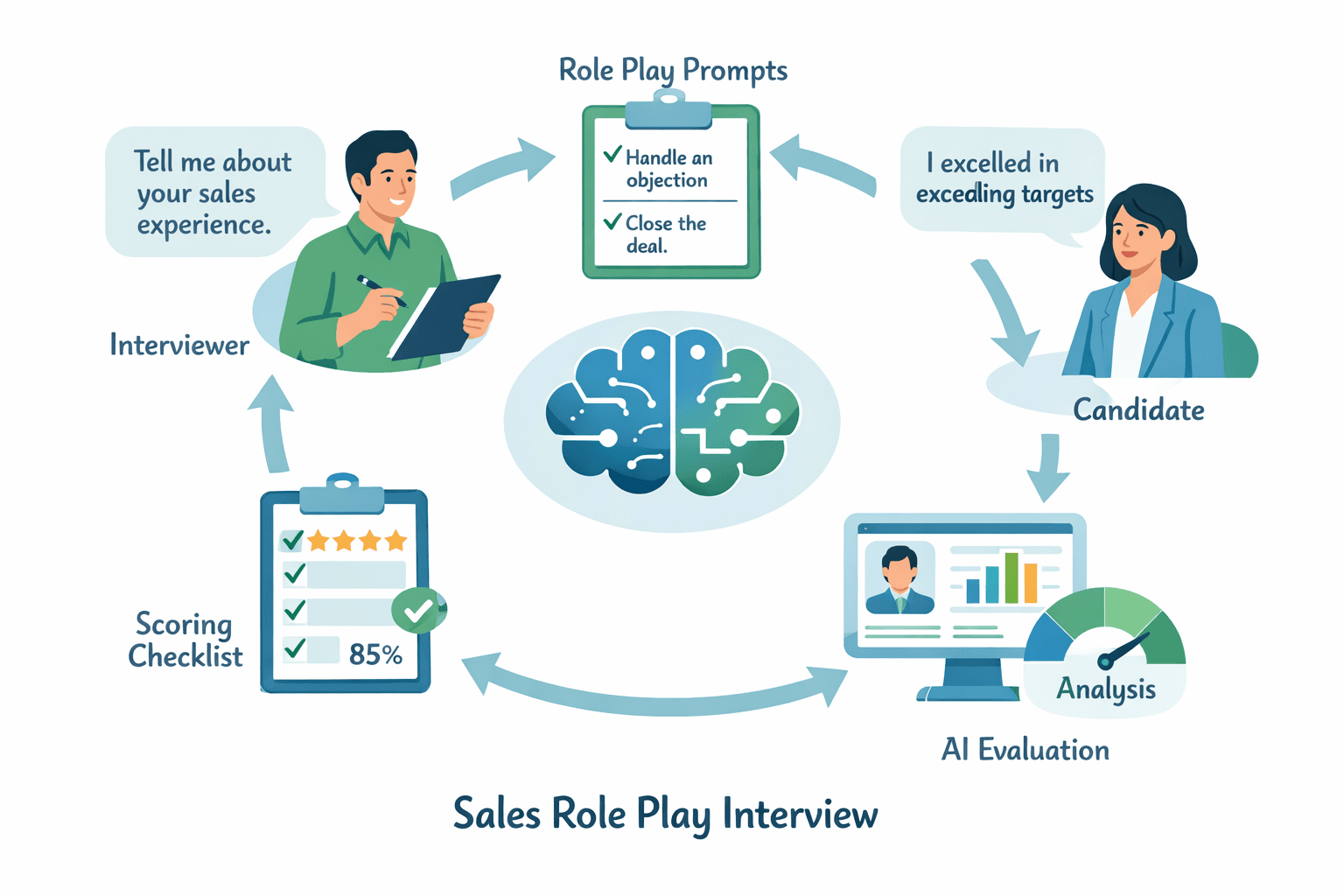
AI-driven sales role play fundamentally changes this dynamic. Instead of static scripts, AI roleplay platforms simulate realistic buyer behavior, objections, emotions, and decision paths. These simulations adapt in real time based on how the rep responds, forcing sellers to think critically, listen actively, and adjust their approach—just as they would in a real conversation.
New reps can practice multiple sales role play scenarios, including discovery calls, objection handling, pricing discussions, competitive positioning, and closing conversations, all within a safe, repeatable environment. This makes sales training simulations far more effective at building real selling skills.
Research from Harvard Business Review consistently shows that experiential learning and active practice dramatically improve retention and skill transfer compared to passive learning methods. Sales role play powered by AI aligns directly with this principle by enabling reps to learn through doing, not just listening or memorizing.
Click on use AI-powered sales training platforms for role-play practice.
How to Train New Sales Reps Using Sales Role Play and AI Roleplay Frameworks
For leaders looking to modernize onboarding, the key is to design sales role play as a structured, repeatable system rather than a one-time activity. High-performing organizations treat sales role play as a core capability-building mechanism that spans onboarding and early development, not as an isolated training exercise. When embedded correctly, AI-driven sales role play helps new reps transition faster from learning concepts to executing confidently in real buyer conversations.
1. Define the Core Sales Motions New Reps Must Master
The first step is clearly defining the core sales motions that new reps must be able to execute consistently. These are the moments in the sales cycle where performance directly impacts deal outcomes. Typically, these include discovery conversations, value articulation, objection handling, pricing discussions, competitive differentiation, and closing techniques.
Rather than treating these as abstract skills, each motion should be broken down into specific behaviors and decision points. For example, discovery is not just about asking questions, but about asking the right questions, sequencing them effectively, and responding thoughtfully to buyer signals. Each of these motions should then be translated into realistic sales role play scenarios that mirror actual buyer conversations and common deal challenges. This ensures that practice is grounded in real selling conditions rather than theoretical examples.
2. Integrate AI Roleplay Early and Continuously in Onboarding
The second step is integrating AI roleplay early in the onboarding journey instead of treating it as an advanced or optional activity. Traditional onboarding often front-loads product knowledge and process training, delaying real conversation practice until weeks later. This creates a gap between learning and execution.
Sales training simulations should run in parallel with onboarding content. As reps learn about products, buyer personas, and messaging frameworks, they should immediately apply that knowledge in AI-powered role play scenarios. This reinforces learning through application and accelerates confidence-building. Early exposure to realistic conversations also reduces anxiety when reps transition to live selling, making onboarding more effective and less overwhelming.
3. Use AI-Generated Feedback to Personalize Development Paths
The third step is leveraging AI-generated feedback to personalize development at scale. One of the biggest limitations of traditional role play is inconsistent and subjective feedback. AI roleplay platforms solve this by analyzing how reps perform across multiple dimensions, including question quality, clarity of messaging, talk-to-listen ratios, objection handling effectiveness, and conversational flow.
This data allows enablement teams and managers to move beyond generic coaching. Instead of sending all reps through the same training modules, they can tailor coaching paths based on individual strengths and gaps. A rep who struggles with discovery may receive targeted practice scenarios, while another who hesitates during pricing discussions can focus on negotiation simulations. Personalization increases engagement, accelerates skill improvement, and leads to more consistent performance across the team.
4. Reinforce Sales Role Play Beyond Initial Onboarding
The fourth step is reinforcing sales role play well beyond the onboarding phase. Many organizations make the mistake of treating role play as something reps “graduate from” once they start selling. In reality, the need for practice increases as reps encounter more complex deals and higher-level stakeholders.
Ongoing sales role play helps reps prepare for new product launches, competitive threats, evolving buyer expectations, and higher-stakes conversations as they move upmarket. AI-driven simulations can be updated continuously to reflect changing market conditions, ensuring that practice remains relevant. Over time, sales role play becomes a continuous performance tool that supports career progression rather than an onboarding checkbox.
5. Measure Impact and Iterate the Role Play System
The final step is measuring the impact of sales role play and continuously refining the system. Leaders should track metrics such as ramp time, deal progression quality, win rates, and consistency of execution across reps. AI analytics make it possible to connect role play performance directly to real deal outcomes.
By reviewing this data regularly, enablement teams can identify which scenarios drive the greatest improvement and where additional reinforcement is needed. This feedback loop ensures that sales role play evolves alongside the business and remains tightly aligned with revenue goals.
How Sales Teams Use AI Roleplay to Reduce Ramp Time
Many B2B organizations are already seeing measurable impact from AI-powered sales role play. A mid-market SaaS company struggling with long ramp times introduced AI roleplay simulations focused on discovery and objection handling. New reps practiced realistic scenarios daily during their first month, receiving immediate feedback after each session. Within a single quarter, the company reduced ramp time by more than 25 percent and saw higher-quality early-stage opportunities entering the pipeline.
In another example, an enterprise technology company used sales training simulations to prepare new hires for complex, multi-stakeholder buying environments. AI roleplay allowed reps to practice handling procurement objections, security concerns, and executive-level questions before attending real meetings. Managers reported significantly higher confidence among new reps and fewer deal stalls during the first quarter.
These examples highlight why sales role play, when powered by AI, delivers impact that traditional training cannot match. By creating consistent, realistic practice environments, AI enables faster skill acquisition and more predictable performance.
Click on build structured sales playbooks to support role-based role play.
The Future of Sales Role Play and AI Sales Training Simulations
Looking ahead, sales role play will continue to evolve rapidly alongside advances in artificial intelligence, fundamentally reshaping how organizations develop and scale sales capability. What was once viewed as a training activity will increasingly become an intelligent performance system embedded into the daily rhythm of selling. Future sales training simulations will move far beyond generic scenarios and scripted conversations, becoming deeply adaptive experiences powered by real deal data and live performance insights.
One of the most significant shifts will be the rise of hyper-relevant, context-aware simulations. AI will analyze historical deal data, CRM activity, and conversation intelligence to generate sales role play scenarios tailored to specific industries, deal stages, and buyer personas. A rep preparing for a first discovery call in a mid-market SaaS deal will practice a very different scenario than a rep negotiating enterprise pricing with procurement. This level of relevance will make practice more impactful and directly applicable to real-world selling situations.
AI roleplay will also increasingly support multilingual selling and regional nuances as organizations expand globally. Future simulations will reflect cultural differences, regulatory constraints, and communication styles across regions, allowing reps to practice conversations that feel authentic to local markets. In parallel, highly specialized vertical use cases will emerge, enabling sellers in industries such as fintech, healthcare, or enterprise technology to train against scenarios unique to their buyers’ challenges and compliance requirements.
Predictive coaching will become another defining feature of the future. Instead of only analyzing past performance, AI will proactively identify risks and opportunities before they impact revenue. By examining upcoming deals, buyer engagement signals, and historical patterns, AI will recommend specific role play scenarios designed to address emerging skill gaps. This allows reps to practice the conversations they are most likely to face next, while managers can focus their coaching efforts where they will have the greatest impact. Gartner research consistently shows that organizations embedding AI-driven practice into sales development experience faster skill acquisition and greater consistency across teams.
As these capabilities mature, sales role play will move from being a supplemental training tactic to a core pillar of revenue enablement strategies. It will serve as the connective layer between onboarding, coaching, and execution. Leaders who invest early in AI-powered sales role play will be better positioned to onboard new hires faster, coach teams more effectively, and compete in increasingly complex B2B markets where execution quality is a decisive differentiator.
Click on improve objection handling through realistic sales role play.
Conclusion
Training new sales representatives in today’s environment requires far more than product knowledge and scripted practice. As buyers become more informed and sales conversations more complex, sales leaders must rethink how they prepare reps for real-world execution. Sales role play, when powered by AI, has emerged as one of the most effective ways to bridge the gap between learning and performance.
AI-driven sales role play transforms onboarding from a one-time training event into a continuous capability-building system. By enabling realistic practice, objective feedback, and personalized development at scale, AI roleplay helps new reps build confidence faster, apply skills more effectively, and avoid costly early-stage mistakes. It also gives managers and enablement teams the visibility they need to coach proactively rather than reactively.
More importantly, sales role play is no longer just a training tool—it is becoming a foundational element of modern revenue enablement. When embedded across onboarding, coaching, and ongoing development, it creates consistent execution, shorter ramp times, and more predictable outcomes. Organizations that treat role play as a structured, data-driven system rather than an occasional exercise gain a meaningful advantage in both talent development and revenue performance.
For sales leaders, CROs, and enablement heads, the path forward is clear. Investing in AI-powered sales role play is not about adopting another tool; it is about building a scalable, future-ready approach to developing sales talent. Teams that embrace this shift will onboard faster, coach smarter, and compete more effectively in increasingly complex B2B markets.
Click on automate sales coaching and practice with modern sales enablement tools.
FAQs
What is sales role play and why is it important for new sales reps?
Sales role play allows new reps to practice realistic sales conversations in a safe, low-risk environment. It builds confidence, improves execution, and reduces costly mistakes before engaging real buyers.How does AI roleplay differ from traditional role play?
AI roleplay provides realistic buyer simulations, consistent scenarios, and objective feedback at scale, unlike traditional role play which is often subjective and difficult to standardize.What types of sales role play scenarios should new reps practice?
New reps should practice discovery calls, objection handling, pricing conversations, competitive positioning, and closing scenarios.Can sales training simulations reduce ramp time?
Yes. Research shows that experiential learning and practice-based simulations significantly reduce ramp time and improve early-stage performance.Is AI roleplay suitable for experienced sales reps as well?
Absolutely. Experienced reps use AI roleplay to prepare for complex deals, new markets, and executive-level conversations.How often should sales role play be used during onboarding?
Sales role play should be embedded throughout onboarding and continued regularly during the first 90 days and beyond.What metrics should leaders track to measure effectiveness?
Key metrics include ramp time, deal progression quality, win rates, skill improvement scores, and consistency across reps.How does sales role play support revenue enablement?
It improves execution, reinforces coaching, and aligns seller behavior with revenue outcomes.What industries benefit most from AI-driven sales role play?
SaaS, enterprise technology, fintech, and B2B services benefit significantly due to complex buying cycles.How will sales role play evolve in the future?
It will become more adaptive, predictive, and embedded into daily sales workflows through AI.
References
Saleshood: AI Role Play for Sales Enablement & Coaching — Explains how AI role play tools deliver personalized feedback, simulate real conversations, and act like an on-demand coach for reps. SalesHood
Highspot: How AI Sales Role Play Tools Help Managers Coach Reps — Focuses on how AI role play enables scalable coaching, consistent feedback, and improved onboarding for sales managers and reps. Highspot
Training Industry: Why AI-Powered Role Play Is the Future of Sales Training — Argues that AI role play delivers dynamic, measurable, repeatable practice experiences that improve onboarding, skill retention, and performance. trainingindustry.com
Mindtickle: How Managers Can Use AI Sales Role Play Tools to Coach Reps — Shows how AI role play helps leaders identify skill gaps, assign targeted simulations, and link rep practice with revenue impact. Mindtickle
Allego: What’s New in AI Sales Training Role Play for 2025 — Provides insights into how modern AI role play has evolved to become more adaptive, realistic, and scalable for new rep training and confidence building. Allego
Learn more about


Try our AI Roleplay Bots for Free
Reduce Ramp-Up time by
47%
and double your sales productivity
Maxim Dsouza is the Chief Technology Officer at Eubrics, where he drives technology strategy and leads a 15‑person engineering team. Eubrics is an AI productivity and performance platform that empowers organizations to boost efficiency, measure impact, and accelerate growth. With 16 years of experience in engineering leadership, AI/ML, systems architecture, team building, and project management, Maxim has built and scaled high‑performing technology organizations across startups and Fortune‑100. From 2010 to 2016, he co‑founded and served as CTO of InoVVorX—an IoT‑automation startup—where he led a 40‑person engineering team. Between 2016 and 2022, he was Engineering Head at Apple for Strategic Data Solutions, overseeing a cross‑functional group of approximately 80–100 engineers.