Sales Effectiveness

Nikita Jain

Introduction
Discovery calls are the foundation of successful selling. Yet, many sales reps struggle to ask the right questions, listen actively, and uncover real customer pain points. Poor discovery leads to weak qualification, misaligned proposals, and stalled deals. This is why organizations increasingly focus on training sales reps on discovery calls using role play—a practical method that builds real conversational skills, not just theoretical knowledge.
Role play allows sales reps to practice discovery conversations in a safe, controlled environment before speaking with real prospects. Instead of memorizing scripts, reps learn how to think, respond, and adapt in real time. When done correctly, role play helps standardize discovery quality across the sales team while improving confidence and consistency.
Why are discovery calls so difficult for sales reps?
Because discovery requires active listening, critical thinking, and adaptability—not just product knowledge or pitch delivery.
How does role play improve discovery call skills?
Role play simulates real buyer conversations, allowing reps to practice questioning, listening, and probing without the risk of losing a deal.
What makes role play more effective than traditional training?
It focuses on doing rather than knowing. Reps learn through practice, feedback, and repetition instead of passive learning.
Who should participate in discovery call role play?
Both new hires and experienced reps benefit, as discovery skills must evolve with markets, buyers, and products.
How often should discovery role play be used in sales training?
Short, regular role play sessions are more effective than infrequent, intensive workshops.
Training sales reps on discovery calls using role play turns abstract concepts into practical skills. In the next sections, we’ll explore how to structure effective role play sessions, what scenarios to use, and how managers can coach discovery skills consistently across the team.
How to Structure Role Play Sessions for High-Impact Discovery Call Training
Once the importance of role play in discovery training is clear, the next step is structuring it correctly. Poorly designed role play sessions can feel artificial, uncomfortable, or unproductive. Well-structured role play, however, closely mirrors real buyer conversations and helps sales reps build practical, repeatable discovery skills that transfer directly to live calls.
The foundation of effective discovery role play is realism. Scenarios should reflect actual buyer personas, industries, and challenges your sales reps encounter. Generic scenarios lead to scripted responses, while realistic situations force reps to think critically, ask better questions, and adapt their approach based on buyer responses.
Role play sessions should focus on process, not pitch. Discovery is about understanding, not convincing. Reps must be trained to resist the urge to talk too much and instead practice curiosity, listening, and follow-up questioning.
A structured discovery role play session typically progresses through clear stages:
Setting the context by defining the buyer persona, company background, and objective of the call
Practicing call opening techniques that establish rapport and agenda
Exploring buyer challenges through open-ended and probing questions
Practicing active listening and summarization
Handling early objections or pushback during discovery
Closing the discovery call with next steps
Each role play should emphasize one or two discovery skills rather than trying to cover everything at once. This targeted approach prevents overload and improves skill retention.
Key skills to practice during discovery role play include:
Asking open-ended, non-leading questions
Probing deeper into surface-level answers
Identifying business impact and urgency
Clarifying decision-making processes
Listening without interrupting or pitching prematurely
Feedback is where learning truly happens. After each role play, feedback should be immediate, specific, and behavior-focused. General comments such as “good job” or “ask better questions” are ineffective. Instead, feedback should reference exact moments in the conversation.
Effective feedback practices include:
Highlighting strong discovery questions used
Identifying missed follow-up opportunities
Pointing out moments where reps shifted into pitching too early
Reinforcing good listening and summarization
How long should a discovery role play session last?
Short sessions of 10–20 minutes per role play work best, allowing focused practice without fatigue.
Should discovery role play be scripted or unscripted?
It should be semi-structured. Clear objectives and buyer context should be defined, but responses should remain unscripted to mimic real conversations.
Who should play the buyer role during discovery training?
Managers, peers, or AI-based role play tools can all be effective, as long as buyer behavior is consistent and realistic.
Repetition is critical. One-off role play sessions do not create lasting improvement. Discovery role play should be built into onboarding, weekly team meetings, and coaching routines. Reps improve significantly when they practice similar scenarios multiple times with increasing difficulty.
To scale discovery role play across teams, organizations often:
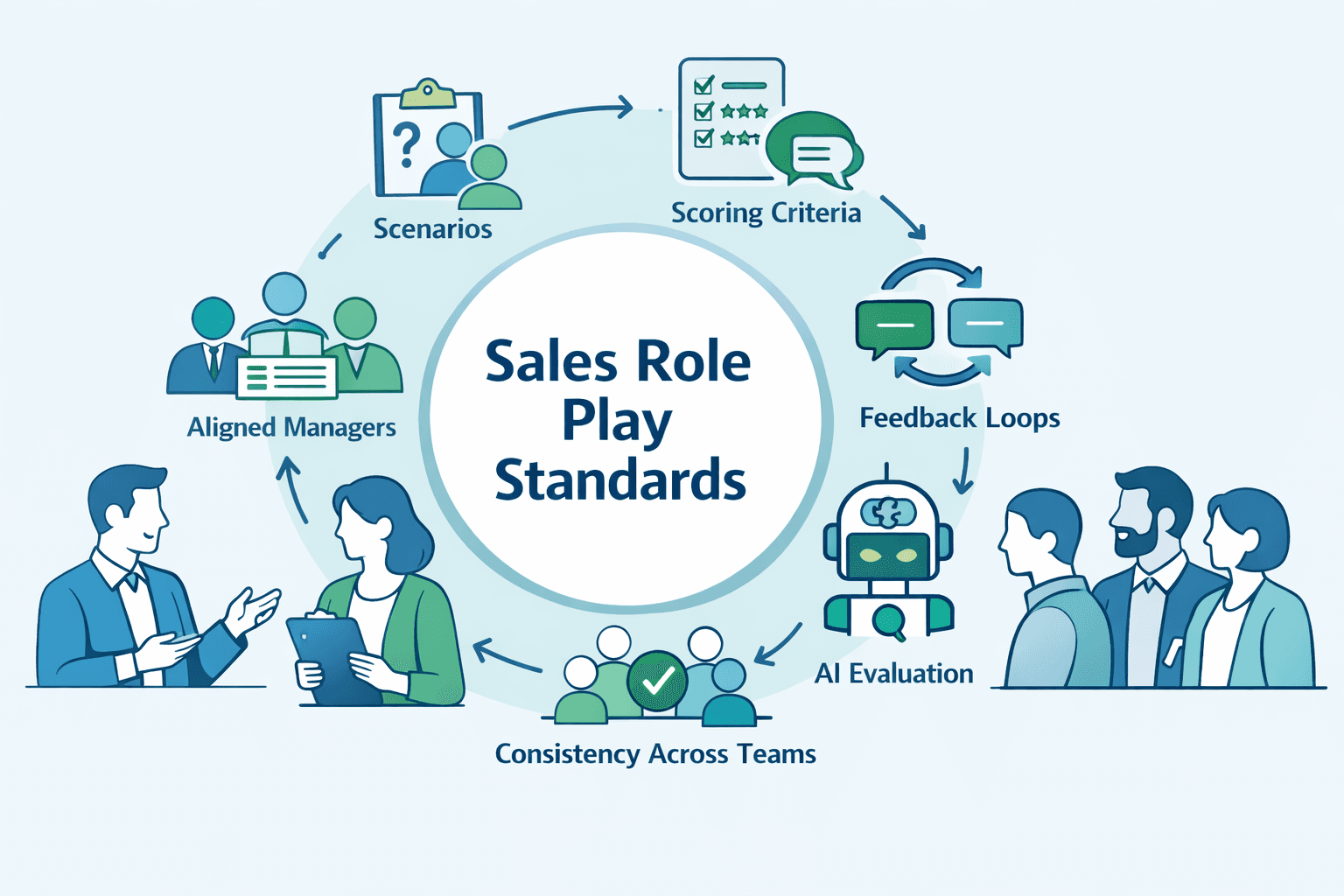
Standardize role play scenarios and evaluation criteria
Rotate focus skills each week
Record role plays for review and coaching
Combine human and AI-based role play for consistency
Finally, managers must model the behavior they expect. When managers demonstrate effective discovery questioning and listening during coaching sessions, reps are more likely to adopt those behaviors in real calls.
Click on improve listening skills during discovery calls.
By structuring discovery role play with clear objectives, realistic scenarios, focused feedback, and regular repetition, organizations can dramatically improve how sales reps conduct discovery calls—leading to better qualification, stronger pipeline, and higher win rates.
Coaching and Reinforcing Discovery Call Skills Through Role Play
After structuring effective role play sessions, the next critical step is coaching and reinforcement. Discovery skills do not improve through practice alone; they improve when practice is consistently reinforced with focused coaching, reflection, and follow-up. For sales teams, especially growing or distributed ones, role play becomes the bridge between training and real customer conversations.
Coaching discovery calls through role play helps sales reps internalize good habits. It shifts learning from theory to muscle memory. When reps repeatedly practice asking thoughtful questions, pausing to listen, and summarizing buyer pain, these behaviors begin to show up naturally in live calls.
Effective coaching starts with clarity. Sales leaders and managers must be aligned on what great discovery looks like in their organization. Without shared standards, feedback becomes subjective and confusing for reps.
Strong discovery coaching focuses on:
Quality of questions, not quantity
Depth of follow-up rather than surface-level probing
Listening behaviors such as pauses and paraphrasing
Ability to uncover business impact and urgency
Avoidance of premature pitching
Role play creates a controlled environment where these behaviors can be observed clearly. Managers can pause conversations, rewind moments, and ask reps to try alternative approaches—something that is impossible during real customer calls.
Click on understand buyer behavior to improve questioning.
What should managers listen for during discovery role play?
Managers should listen for curiosity, structure, and restraint—whether the rep lets the buyer speak and explores answers deeply.
How often should discovery role play be coached?
Discovery role play should be coached regularly, ideally weekly or biweekly, to build consistency and confidence.
Can discovery coaching scale across large teams?
Yes. Standardized role play scenarios and clear coaching criteria make it easier to coach consistently across managers and regions.
Feedback during discovery role play must be specific and actionable. Generic advice does not help reps improve. Instead, feedback should reference exact moments in the role play and explain why a different approach would be more effective.
High-impact feedback practices include:
Calling out strong discovery questions used by the rep
Identifying missed opportunities to dig deeper
Highlighting moments where the rep interrupted the buyer
Reinforcing effective summarization and validation
Reinforcement should not end after the role play session. Managers should connect role play feedback to real sales activity. This helps reps see the relevance of practice and apply learning immediately.
Ways to reinforce discovery role play in daily work include:
Asking reps to apply one discovery skill on their next live call
Reviewing call recordings and comparing them to role play performance
Tracking improvement in discovery quality over time
Revisiting the same scenario with increased complexity
Technology can further strengthen reinforcement. AI-based role play tools allow reps to practice discovery conversations independently and receive instant feedback. This reduces dependency on manager availability and ensures consistent practice opportunities.
When AI role play is combined with manager coaching:
Reps get unlimited practice without pressure
Managers focus on higher-level coaching conversations
Feedback becomes more objective and data-driven
Skill gaps are identified faster
Another important aspect of reinforcement is progression. Discovery role play should evolve as reps improve. Early sessions may focus on basic questioning, while later sessions introduce complex buyers, multiple stakeholders, or resistant prospects.
Progressive discovery role play scenarios often include:
Price-sensitive buyers
Indecisive or skeptical stakeholders
Multiple pain points competing for attention
Ambiguous problems requiring deeper exploration
Finally, consistency matters more than intensity. Short, focused role play sessions repeated over time produce better results than long, infrequent workshops. When discovery role play becomes a routine part of coaching, sales reps develop confidence, curiosity, and control in conversations.
By coaching and reinforcing discovery skills through structured role play, organizations ensure that discovery excellence is not limited to top performers. Instead, it becomes a shared capability across the sales team—leading to better qualification, stronger pipelines, and more successful deals.
How to Measure and Scale Discovery Call Training with Role Play
As organizations mature their discovery call training, the focus shifts from practice alone to measurement and scalability. Role play is most powerful when leaders can see clear improvement over time, identify common gaps, and scale best practices across the entire sales organization. Without measurement, discovery training risks becoming repetitive without delivering sustained performance gains.
Effective discovery training measurement starts by defining what success looks like. Discovery is not about talking more—it’s about learning more. Metrics should reflect quality of conversation, not volume of questions or call length. Role play provides a controlled environment where these behaviors can be observed, evaluated, and improved consistently.
Midway through the training process, sales leaders often ask critical questions about impact and scalability.
Click on practice sales role play for discovery conversations.
How do we know if discovery role play is actually improving real sales calls?
Improvement shows up when reps ask deeper questions, uncover clearer pain points, and progress opportunities with stronger qualification.
What behaviors should be measured during discovery role play?
Listening quality, follow-up depth, problem framing, and the ability to summarize buyer needs accurately.
Can discovery training scale without overwhelming managers?
Yes. When role play scenarios, scoring criteria, and feedback frameworks are standardized, managers coach faster and more effectively.
Once these questions are addressed, organizations can move confidently into scalable execution. The next step is building a repeatable measurement and reinforcement system around role play.
Key metrics to track during discovery role play include:
Quality of open-ended questions asked by reps
Frequency and depth of follow-up questions
Percentage of buyer talk time versus rep talk time
Accuracy of problem and impact summarization
Consistency in setting clear next steps
These metrics should be tracked over time rather than evaluated in isolation. Trends reveal whether reps are improving or plateauing. This longitudinal view helps leaders intervene early when skills are not progressing as expected.
Click on use AI roleplay calls for discovery training.
To scale discovery role play effectively, organizations standardize both scenarios and evaluation. Every rep should practice the same core discovery situations, especially during onboarding and skill refresh cycles. This ensures fairness, consistency, and comparability across teams.
Scalable discovery role play frameworks typically include:
Core scenarios aligned to ideal customer profiles
Progressive difficulty levels as reps improve
Clear scoring rubrics tied to discovery competencies
Shared feedback language across managers
Technology further enables scale by reducing manual effort. AI-powered role play tools allow reps to practice discovery independently while generating structured feedback. Managers can then focus on reviewing insights instead of running every practice session themselves.
When AI role play is integrated into discovery training:
Reps practice more frequently without scheduling barriers
Feedback becomes immediate and objective
Skill gaps are identified faster across teams
Managers coach using data instead of intuition
Another critical element of scaling is reinforcement alignment. Role play insights should directly inform coaching conversations, team training sessions, and performance reviews. When discovery training feels disconnected from daily selling, adoption drops.
Effective reinforcement practices include:
Using role play feedback as input for one-on-one coaching
Highlighting strong discovery examples in team meetings
Revisiting common gaps through targeted role play sessions
Linking discovery performance to pipeline quality metrics
Finally, discovery role play must evolve alongside the business. As products change, markets shift, or buyer behavior evolves, scenarios should be updated to remain realistic and relevant. Static role play loses effectiveness quickly.
Continuous improvement actions include:
Quarterly review of discovery scenarios
Updating buyer personas and objections
Refining evaluation criteria based on real call analysis
Gathering rep feedback on role play realism
By measuring discovery behaviors, standardizing role play execution, and reinforcing learning consistently, organizations turn discovery training into a scalable capability rather than a one-time initiative. This disciplined approach ensures that strong discovery conversations become the norm across the sales team—driving better qualification, stronger pipelines, and higher win rates at scale.
Conclusion
Training sales reps on discovery calls using role play is one of the most effective ways to improve qualification quality, pipeline health, and win rates. Discovery is a skill that cannot be mastered through theory alone—it requires repeated practice, structured feedback, and consistent reinforcement. Role play creates a safe environment where reps can experiment, refine questioning techniques, improve listening skills, and build confidence before engaging real prospects. When organizations standardize discovery role play, measure behavior quality, and scale practice through structured frameworks and technology, discovery excellence becomes a team-wide capability rather than an individual strength. Over time, this leads to better buyer conversations, clearer problem understanding, and more predictable sales outcomes.
Frequently Asked Questions
1. Why is discovery call training important for sales reps?
Because strong discovery uncovers real buyer needs, improves qualification, and prevents wasted sales effort.
2. How does role play improve discovery call skills?
It allows reps to practice questioning, listening, and probing in realistic scenarios without risk.
3. How often should discovery role play be conducted?
Short, regular sessions—weekly or biweekly—deliver the best results.
4. Should discovery role play be scripted?
No. It should be semi-structured to allow natural, adaptive conversations.
5. Who should facilitate discovery role play?
Sales managers, peers, or AI-based role play tools can all be effective.
6. Can experienced reps benefit from discovery role play?
Yes. Discovery skills must evolve with markets, buyers, and products.
7. What skills should be measured during discovery role play?
Question quality, listening depth, follow-up probing, and summarization accuracy.
8. How does role play support sales coaching?
It gives managers observable behavior to coach rather than relying on assumptions.
9. Can discovery role play scale across large teams?
Yes, when scenarios and evaluation criteria are standardized.
10. What is the biggest mistake in discovery role play training?
Treating it as a one-time activity instead of an ongoing practice system.
Learn more about


Try our AI Roleplay Bots for Free
Reduce Ramp-Up time by
47%
and double your sales productivity
Nikita Jain is a dynamic CEO and recognized leader passionate about harnessing technology and capability development to unlock the full potential of individuals and organizations. With over a decade of rich experience spanning enterprise learning, digital transformations, and strategic HR consulting at top firms like EY, PwC, and Korn Ferry, Nikita excels at driving significant, measurable success.