Sales Effectiveness

Maxim Dsouza
Introduction
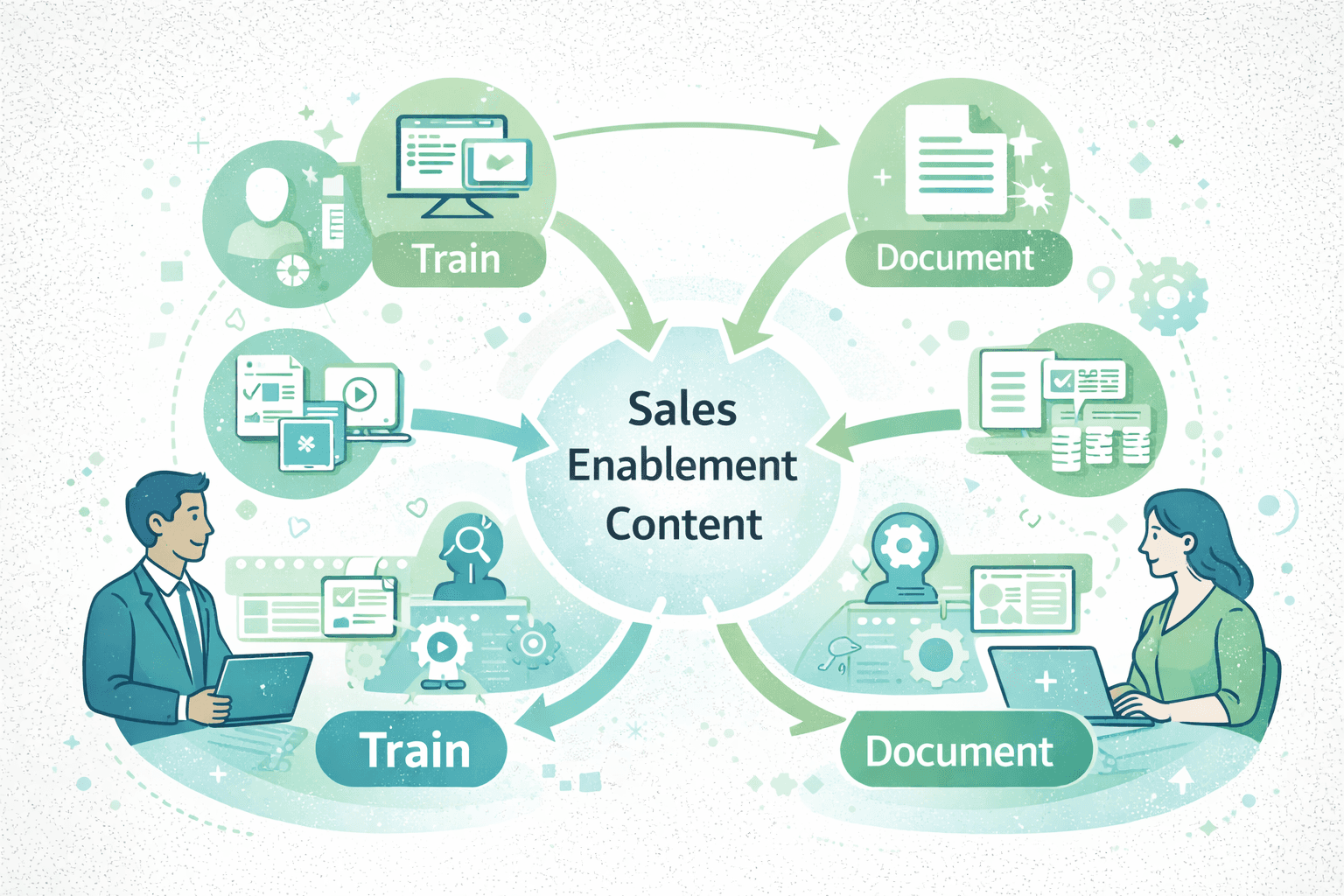
Sales enablement teams create large volumes of content over time. Training decks, playbooks, battlecards, SOPs, FAQs, demo scripts, and onboarding guides quickly accumulate as organizations grow. The issue is not a lack of content but a lack of clarity on what should be trained versus what should be documented.
When everything is treated as training, reps feel overloaded and disengaged. Managers still see gaps in execution, and enablement teams struggle to balance live sessions with usable documentation. Training time is expensive and pulls reps away from selling, yet much of what is trained does not require memorization or practice.
Training exists to change behavior. Documentation exists to support recall. When this distinction is unclear, critical selling skills receive too little practice while low impact information is repeated in live sessions.
A sales enablement content audit brings structure by clearly separating what must be trained, what should be documented, and what can be removed. This clarity reduces training fatigue, improves skill adoption, and makes enablement content easier for reps to use in the flow of work.
Click on understand the difference between sales enablement and sales training.
Auditing Sales Enablement Content: Separating Training from Reference
Sales enablement content audits usually start because something feels off. Reps say they are attending too many sessions but still feel unprepared. Managers notice that the same questions keep coming up. Enablement teams feel busy, yet impact is hard to prove. These symptoms point to a deeper issue: content has grown without intention.
Most sales organizations accumulate content organically. Every new product, process change, objection, or internal update becomes a slide deck or training session. Over time, the distinction between learning and reference disappears. Everything is treated as equally important, and reps are expected to remember it all.
This creates three predictable problems. First, attention drops. Reps tune out during training because much of the content does not require behavior change. Second, retention drops. When too much information is pushed through training, very little sticks. Third, execution suffers. Critical skills don’t get enough focus or practice because training time is diluted.
At this point, enablement leaders usually pause with some key questions.
Why do reps keep asking basic questions even after multiple trainings?
Because the information they need is reference-level knowledge that should be documented, not memorized through training.
Why does training feel repetitive but performance still doesn’t improve?
Because sessions are covering information instead of building skills that require practice and reinforcement.
How do we know what content actually deserves live training time?
By identifying content that directly affects selling behavior and deal outcomes.
A content audit helps answer these questions systematically. The goal is not to reduce content volume blindly, but to categorize content based on how it should be consumed and applied.
A useful way to think about this is cognitive load. Training should focus on things reps must internalize and execute under pressure. Documentation should support things reps can look up in the moment.
During an audit, enablement teams often discover that a large portion of their “training” content does not meet the bar for training. Product specs, internal workflows, pricing edge cases, and policy details usually belong in documentation, not live sessions.
Common signs that content should be documented rather than trained include:
Information that is used infrequently
Details that change often
Content that reps can easily reference during a deal
Knowledge that does not require judgment or practice
Material that answers “what” rather than “how”
On the other hand, training-worthy content shares different characteristics. It influences how reps think, decide, and act in live conversations. It is hard to apply without practice and feedback.
Content that typically belongs in training includes:
Core selling skills like discovery and objection handling
Product positioning tied to buyer problems
Decision frameworks for choosing what to sell and when
Conversation structure and messaging
Behaviors that directly affect deal progression
Another important insight from audits is redundancy. Many teams train the same concept in different formats without realizing it. Reps hear similar messages in onboarding, product updates, and quarterly enablement sessions. This repetition crowds out deeper skill practice.
Audits also reveal gaps. While there may be plenty of content explaining products, there is often very little focused on how reps should apply that knowledge in real scenarios. Training becomes informational instead of transformational.
A strong audit process does not stop at classification. It also asks whether content is still relevant. Outdated or low-impact material should be archived or removed. Every piece of content kept should have a clear purpose.
When enablement teams complete this step, a shift happens. Training calendars become lighter but more impactful. Documentation becomes easier to navigate. Reps stop feeling overwhelmed and start trusting enablement again.
Most importantly, enablement regains credibility. Instead of being seen as a source of noise, it becomes a source of clarity. Reps know when they need to learn deeply and when they just need to look something up.
Building an Intent-Driven Enablement Content System
A sales enablement content audit works best when there is a clear, repeatable decision framework. Without structure, teams debate content endlessly and fall back into old habits of training everything. The goal is to create an arranged process that helps enablement teams consistently decide what to train, what to document, and what to remove.
The starting point is intent. Every piece of content exists for a reason, but that reason is often unclear over time. Content should be evaluated based on how it is used in real selling moments, not how important it feels internally.
What problem does this content solve for a rep during a live deal?
If the answer is unclear, the content likely does not deserve training time.
Next comes frequency. Content that reps use daily or weekly carries more weight than content used occasionally. High-frequency content deserves deeper learning investment, while low-frequency content should be easy to reference.
How often does a rep need this information while selling?
If it is needed rarely, documentation is usually the better choice.
The third lens is cognitive demand. Some content requires judgment, pattern recognition, and practice. Other content is factual and can be looked up. This distinction is critical.
Does this content require practice to apply correctly under pressure?
If yes, it belongs in training. If no, it belongs in documentation.
Once these questions are answered, content can be arranged into clear categories.
Content that should be trained typically includes:
Core selling skills that shape live conversations
Product positioning tied to buyer problems and outcomes
Decision frameworks for product selection or deal strategy
Objection handling and negotiation approaches
Messaging that must sound natural, not read verbatim
Training content should be limited, focused, and reinforced through practice. If content cannot be practiced meaningfully, it usually does not belong in training.
Content that should be documented typically includes:
Detailed product specifications and feature lists
Pricing tables, packaging details, and edge cases
Internal processes, approvals, and workflows
Competitive fact sheets and reference comparisons
Policy updates and operational guidelines
Documentation should be easy to search, skimmable, and accessible in the flow of work. Its success is measured by speed of retrieval, not memorization.
A third category often emerges during audits: content that should be removed or archived. Over time, enablement libraries accumulate outdated, redundant, or low-impact material that adds noise without value.
Common signals that content should be removed include:
No clear owner or update cadence
Rare or no usage by reps
Information duplicated elsewhere
Content tied to retired products or processes
Material that no longer reflects how selling happens
Arranging content this way immediately reduces overload. Reps stop being trained on things they can easily look up. Training time is reserved for skill-building, not information transfer.
Another important step is sequencing. Training should not attempt to cover all train-worthy content at once. Core skills come first, followed by advanced or situational skills as reps mature. Documentation supports this journey by filling in details as needed.
This clarity also transforms manager coaching. When managers know what was meant to be trained versus documented, coaching becomes more consistent. Managers reinforce trained behaviors and point reps to documentation instead of re-explaining details.
Over time, this arrangement creates trust. Reps learn that if something shows up in training, it truly matters. If something is documented, it is reliable and easy to find. Enablement stops competing for attention and starts earning it.
A structured sales enablement content audit is not a one-time cleanup exercise. It becomes a design principle. New content is created with intention from day one—either as training, documentation, or not at all.
When teams adopt this approach, sales enablement becomes lighter, clearer, and more effective. Training drives behavior change. Documentation supports execution. And reps spend less time overwhelmed and more time selling with confidence.
Click on use sales playbooks and documentation for consistent execution.
Sustaining the Audit: Governance and Reinforcement Over Time
A sales enablement content audit only creates lasting value when the decisions it produces are enforced and revisited over time. Many teams do a one-time cleanup, feel relief, and then slowly slip back into old habits—training everything, documenting inconsistently, and overwhelming reps again. The difference between a useful audit and a lasting system is governance and reinforcement.
At this stage, the focus shifts from categorizing content to operationalizing decisions. Reps need to experience the distinction between training and documentation consistently. Managers need to reinforce it in coaching. Enablement needs to protect training time and keep documentation usable.
In the middle of this shift, teams usually confront a few practical questions.
How do we stop new content from automatically becoming training?
By requiring every new asset to pass the same train-vs-document criteria before it’s created or rolled out.
What happens when stakeholders insist their content must be trained?
The decision should be based on behavior impact and cognitive demand, not internal urgency or preference.
How often should a sales enablement content audit be revisited?
Light reviews quarterly work better than large, disruptive cleanups once a year.
Once these questions are settled, teams need simple operating rules that guide everyday decisions. The goal is to reduce debate and make the right choice obvious.
Effective operating principles for sustaining audit decisions include:
Training is reserved only for content that requires behavior change and practice
Documentation is the default for information that supports recall and reference
No training session exists without a clear skill outcome
No document exists without a defined use case and owner
Outdated or unused content is archived regularly
Another critical element is manager alignment. Managers are the strongest signal reps receive about what matters. If managers continue to explain documented details in coaching, reps assume everything is training-worthy. When managers consistently redirect reps to documentation for reference topics, the distinction sticks.
Enablement teams should support managers by:
Clearly labeling content as training or documentation
Reinforcing what was intentionally trained during coaching enablement
Providing quick-reference links managers can share instead of re-teaching
Reviewing manager feedback to spot confusion between the two categories
Technology also plays a role, but only if it supports clarity. Reps should immediately know whether they are expected to learn something deeply or simply look it up. Poorly organized libraries erase the benefits of even the best audit.
Strong content systems make it easy to:
Find documentation in seconds during a live deal
Recognize training content by its practice-oriented design
Avoid duplicate or conflicting materials
Trust that content is current and relevant
Another sustaining factor is rep experience. When reps notice that training sessions are shorter, more focused, and clearly tied to real selling skills, engagement increases. When documentation actually answers questions quickly, reps stop asking for retraining.
Over time, this creates a healthy feedback loop. Reps respect training because it is rare and valuable. Documentation gets used because it is reliable. Enablement earns credibility by protecting attention and reducing noise.
Audits should also inform future content creation. Every new product launch, process change, or messaging update should start with a simple decision: does this change how reps behave in conversations, or does it support execution? The answer determines format, rollout, and reinforcement.
When this discipline is applied consistently, sales enablement shifts from content production to capability building. Training drives behavior change. Documentation supports execution. Reps feel less overwhelmed and more confident.
A well-maintained sales enablement content audit is not about doing less work—it’s about doing the right work. By keeping the line between training and documentation clear, teams protect selling time, improve skill adoption, and make enablement truly useful in the flow of sales.
Conclusion
A sales enablement content audit brings focus to one of the most overlooked problems in enablement: trying to train everything. When teams clearly separate what must be trained from what should be documented, attention is protected and impact improves. Training becomes about behavior change and skill application, while documentation supports fast, reliable recall in the flow of work. This clarity reduces rep fatigue, improves adoption, and makes enablement easier to scale. Teams that audit content regularly stop reacting to noise and start building real sales capability with intention.
Click on improve sales team performance with structured enablement content.
FAQs
What is a sales enablement content audit?
It is a structured review of enablement content to decide what should be trained, documented, or removed.Why is it important to separate training from documentation?
Because training changes behavior, while documentation supports reference and recall.What content should always be trained?
Core selling skills, positioning, decision frameworks, and behaviors used in live conversations.What content should usually be documented instead of trained?
Product details, pricing specifics, internal processes, and infrequently used information.How does this audit reduce training fatigue?
By limiting training to high-impact skills and moving low-impact information to documentation.Who should own the sales enablement content audit?
Typically sales enablement, with input from sales leaders and managers.How often should enablement teams run a content audit?
Quarterly light reviews work better than infrequent large cleanups.Does documenting more mean training less?
No, it means training more intentionally on what truly matters.How does this help sales managers?
It clarifies what to coach and what to redirect reps to documentation for.Why is this critical for scaling sales teams?
Because clear boundaries prevent overload and keep enablement effective as content grows.
Learn more about


Try our AI Roleplay Bots for Free
Reduce Ramp-Up time by
47%
and double your sales productivity
Maxim Dsouza is the Chief Technology Officer at Eubrics, where he drives technology strategy and leads a 15‑person engineering team. Eubrics is an AI productivity and performance platform that empowers organizations to boost efficiency, measure impact, and accelerate growth. With 16 years of experience in engineering leadership, AI/ML, systems architecture, team building, and project management, Maxim has built and scaled high‑performing technology organizations across startups and Fortune‑100. From 2010 to 2016, he co‑founded and served as CTO of InoVVorX—an IoT‑automation startup—where he led a 40‑person engineering team. Between 2016 and 2022, he was Engineering Head at Apple for Strategic Data Solutions, overseeing a cross‑functional group of approximately 80–100 engineers.