Sales Effectiveness

Nikita Jain
Introduction
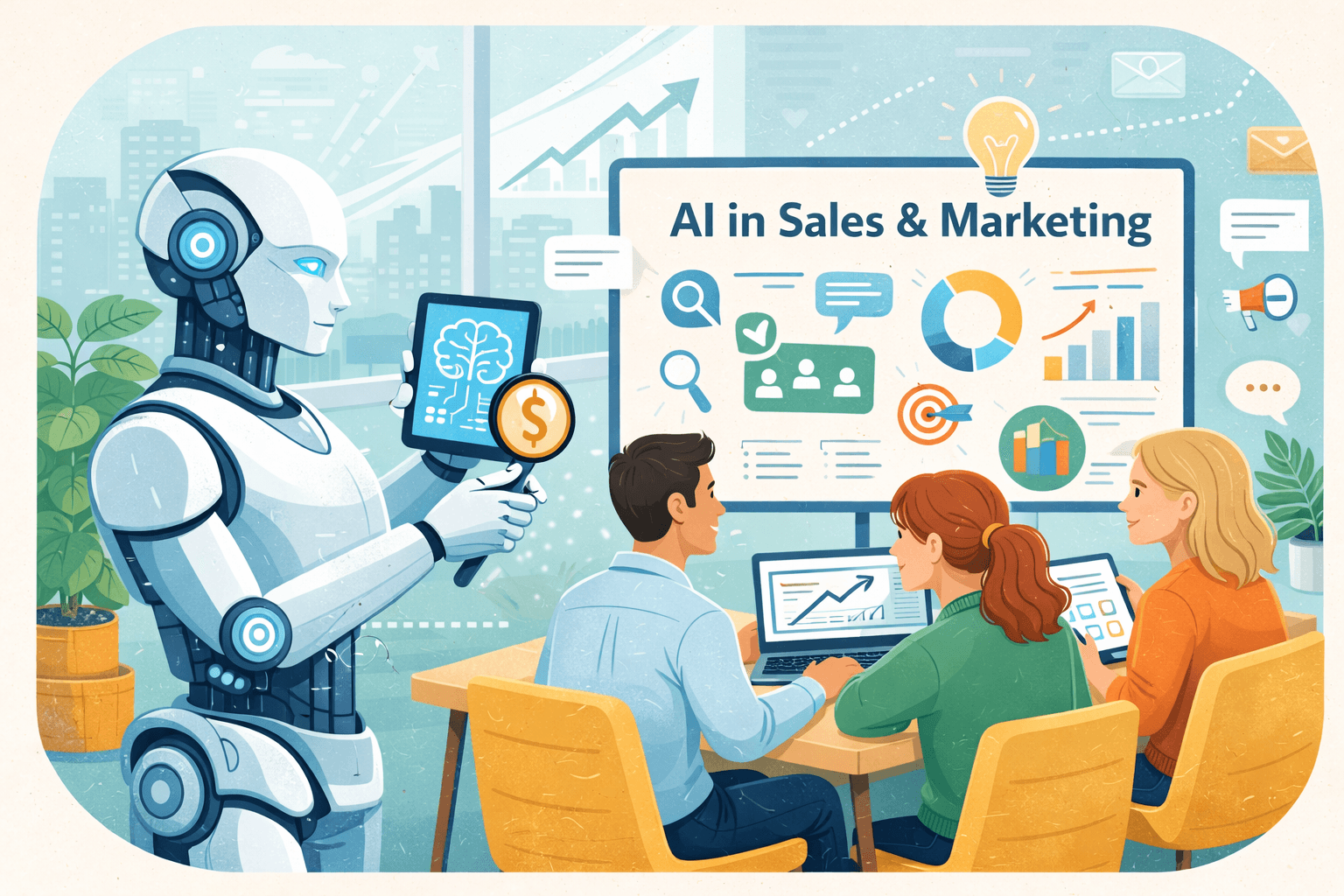
AI in sales and marketing is no longer an emerging trend—it is rapidly becoming the operating system for modern revenue teams. As buyer behavior shifts, sales cycles lengthen, and markets grow more competitive, traditional approaches to selling and marketing are proving insufficient. Sales leaders and CROs are under pressure to drive predictable growth, improve forecast accuracy, and scale performance without proportionally increasing headcount. At the same time, marketing leaders must deliver higher-quality pipeline while navigating declining conversion rates and rising customer acquisition costs.
This is where AI in sales and marketing has fundamentally changed the equation. Rather than acting as a point solution, AI now supports the entire revenue lifecycle—from demand generation and lead qualification to sales coaching, deal execution, and forecasting. According to McKinsey, companies that adopt AI across commercial functions report revenue increases of up to 10–15%, driven by better decision-making and execution efficiency.
Click on Best AI Tools for Sales to explore how modern sales teams are applying AI across the funnel today.
Yet despite the promise, many organizations struggle to move from theory to practice. Leaders often ask: What does AI actually do for sales and marketing teams today? Where does it deliver real value? And how can it be applied without overcomplicating the tech stack?
This article answers those questions by breaking down 10 practical, real-world use cases of AI in sales and marketing—focused not on hype, but on execution, outcomes, and revenue impact.
What AI in Sales and Marketing Really Means Today
At its core, AI in sales and marketing refers to the application of machine learning, natural language processing, predictive analytics, and automation to improve how revenue teams operate. Unlike earlier automation tools that focused primarily on efficiency, modern AI systems focus on intelligence—understanding patterns, predicting outcomes, and guiding human action.
In sales, AI is increasingly used for forecasting, pipeline health analysis, deal coaching, roleplay simulations, and behavioral insights. In marketing, AI supports audience segmentation, personalization, content optimization, attribution modeling, and campaign performance prediction. What unites these use cases is the ability to turn vast amounts of data into actionable insight at scale.
Click on How to Use AI in Sales to understand how these capabilities are being operationalized inside modern CRM workflows.
Importantly, AI does not replace human sellers or marketers. Instead, it augments them by removing guesswork, reducing manual effort, and highlighting what matters most. As Gartner notes, “AI does not sell—it enables sellers to sell better.”
10 Practical Use Cases of AI in Sales and Marketing
1. AI-Powered Lead Scoring and Qualification
One of the most widely adopted applications of AI in sales and marketing is intelligent lead scoring. Traditional lead scoring models rely on static rules, such as job title or website visits, which often fail to capture real buying intent. AI-driven lead scoring models analyze thousands of data points across behavioral, firmographic, and historical conversion data to predict which leads are most likely to convert.
This allows marketing teams to prioritize high-intent leads and sales teams to focus their time where it matters most. According to Salesforce’s State of Sales report, high-performing teams are significantly more likely to use AI-driven lead scoring than underperforming peers.
2. AI-Based Buyer Intent Detection
AI systems now analyze digital behavior—content engagement, search activity, email interaction, and sales conversations—to identify buyer intent signals. These insights help marketing teams deliver more relevant messaging while enabling sales reps to tailor conversations based on what buyers actually care about.
For example, AI can detect when prospects begin comparing vendors or researching pricing, allowing sales teams to intervene at the right moment. This use of AI in sales and marketing significantly improves timing and relevance, two factors that strongly influence conversion rates.
3. Predictive Sales Forecasting
Sales forecasting has traditionally relied on pipeline stages and rep judgment, both of which are prone to bias. AI-driven forecasting models analyze historical deal data, sales activity, buyer behavior, and rep performance patterns to predict outcomes more accurately.
These systems create real-time deal intelligence by identifying risk signals such as stalled conversations, reduced engagement, or changes in buyer sentiment. Gartner predicts that by 2026, most B2B sales organizations will rely primarily on AI-driven forecasting models rather than subjective manager judgment.
4. AI Sales Coaching and Performance Analysis
One of the most impactful uses of AI in sales is coaching. AI-powered sales coaching tools analyze calls, emails, and meetings to identify patterns in messaging, objection handling, and buyer response. Instead of generic feedback, reps receive specific, data-backed guidance on how to improve.
This shifts coaching from reactive to proactive. Managers no longer need to manually review hours of call recordings. AI highlights moments that matter and links behaviors to outcomes, enabling more effective development at scale.
Eubrics SalesBot strengthens AI sales coaching by turning real conversations into targeted practice. It identifies specific skill gaps from calls and automatically maps them to AI-driven roleplays and coaching simulations, allowing reps to improve precisely where deals are at risk—without adding manual effort for managers.
Click on Sales Drills That Improve Sales Performance to see how structured practice reinforces these insights in real selling situations.
5. AI Roleplay Sales Training and Skill Development
AI roleplay sales training is transforming how sales teams build skills. Using AI-driven simulations, reps practice discovery calls, negotiations, and objection handling in a realistic, risk-free environment. These simulations adapt dynamically using AI roleplaying scenarios that mirror real buyer behavior.
Unlike traditional roleplays, AI-based roleplay is repeatable, judgment-free, and available on demand. Organizations using AI roleplay sales training report faster onboarding, improved confidence, and more consistent execution across teams.
6. Call Analysis and Conversation Intelligence
AI-powered conversation intelligence tools analyze sales calls to extract insights about buyer sentiment, objections, and engagement levels. These insights support both sales and marketing teams by revealing what messaging resonates, which objections recur, and where deals tend to stall.
Marketing teams can use this data to refine positioning and content, while sales teams gain actionable feedback to improve live conversations. This creates a powerful feedback loop between sales execution and marketing strategy.
Click on Key LMS Features That Support Sales Enablement to understand how learning systems now integrate directly with call intelligence and coaching workflows.
Eubrics Sales Bot uses call intelligence to convert insights into action. It analyzes real sales conversations to surface buyer sentiment and recurring objections, then feeds those insights directly into AI roleplay and coaching scenarios so reps can practice the exact moments where deals stall.
7. Personalized Content and Messaging at Scale
Personalization is no longer optional in B2B marketing, but manual personalization does not scale. AI enables dynamic personalization by analyzing buyer profiles, intent signals, and engagement history to deliver tailored messaging across channels.
From personalized email copy to dynamic website experiences, AI in sales and marketing allows organizations to deliver relevance without increasing manual workload. McKinsey reports that companies excelling at personalization generate up to 40% more revenue from those activities than average players.
8. Marketing Campaign Optimization and Attribution
AI helps marketing teams optimize campaigns by predicting which channels, messages, and offers will perform best. AI-driven attribution models move beyond last-touch attribution, providing a more accurate view of how different interactions influence conversion.
This allows revenue leaders to allocate budgets more effectively and align marketing spend with pipeline impact, improving ROI and accountability.
9. AI Agents for Sales Enablement and Support
AI agents are increasingly used to support sales teams by answering product questions, surfacing relevant content, and guiding reps during live deals. These agents act as always-on assistants, reducing dependency on managers or enablement teams for basic support.
By embedding AI agents directly into sales workflows, organizations improve rep productivity and reduce friction during critical selling moments.
10. Revenue Intelligence and Cross-Team Alignment
The most advanced use of AI in sales and marketing brings everything together into revenue intelligence platforms. These systems connect marketing data, sales activity, coaching insights, and forecasting into a single view of revenue performance.
This holistic perspective enables better alignment between sales, marketing, and revenue operations, turning AI into a strategic growth engine rather than a collection of disconnected tools.
Conclusion
AI in sales and marketing is no longer a matter of experimentation or early adoption—it has become a question of execution discipline. As AI capabilities mature, the competitive gap is no longer between companies that use AI and those that do not, but between organizations that operationalize AI effectively and those that treat it as a disconnected set of tools. Teams that embed AI into their daily workflows are seeing measurable improvements in productivity, forecast accuracy, deal velocity, and revenue consistency. AI is no longer a side initiative; it is becoming the operating layer that guides how revenue teams plan, prioritize, and perform.
When applied across the full revenue lifecycle—from demand generation and lead qualification to sales coaching, roleplay training, deal execution, forecasting, and revenue intelligence—AI brings clarity to complexity. It replaces guesswork with evidence, intuition with insight, and manual effort with intelligent automation. Sales leaders gain real-time visibility into deal health, marketing teams understand which messages truly influence buyers, and managers can coach based on actual behaviors rather than assumptions. Most importantly, sellers are empowered to focus on high-value conversations, confident that they are prepared, informed, and aligned with buyer intent.
Click on 10 Charts That Will Change Your Perspective of AI in Marketing to see how AI-driven organizations are redefining revenue performance at scale.
What makes this shift truly transformative is not just efficiency, but consistency. AI enables organizations to scale best practices across teams, geographies, and experience levels. New hires ramp faster. Top-performer behaviors are identified and replicated. Coaching becomes continuous rather than episodic. Forecasts become forward-looking instead of reactive. Over time, this creates a compounding advantage where execution improves quarter after quarter, not because teams are working harder, but because they are working smarter.
For sales and marketing leaders, the core question has fundamentally changed. It is no longer whether AI should be adopted—this is now assumed. The real differentiator lies in how quickly and effectively AI can be translated into daily execution, cultural habits, and measurable business outcomes. Organizations that move decisively will not only outperform competitors in the near term but will define the standards of modern revenue execution in the years ahead.
FAQs:
1. What is AI in sales and marketing?
AI in sales and marketing refers to using machine learning and analytics to improve targeting, selling, coaching, forecasting, and revenue performance.
2. How does AI improve sales productivity?
AI reduces manual work, prioritizes high-impact activities, and provides data-driven coaching and insights.
3. Is AI roleplay sales training effective?
Yes. AI roleplay sales training enables realistic, repeatable practice and accelerates skill development.
4. Can AI replace sales reps or marketers?
No. AI augments human performance rather than replacing it.
5. How accurate is AI-driven sales forecasting?
AI-driven forecasting is significantly more accurate than traditional methods because it analyzes behavior and buyer signals.
6. What teams benefit most from AI in sales and marketing?
B2B sales, SaaS, enterprise technology, and revenue operations teams benefit the most.
7. Is AI expensive to implement?
Costs vary, but many AI tools deliver ROI quickly through efficiency and performance gains.
8. How does AI help sales enablement?
AI supports coaching, roleplay, onboarding, and skill measurement at scale.
9. What data does AI use for sales insights?
AI uses CRM data, call recordings, emails, marketing interactions, and historical deal outcomes.
10. What is the future of AI in sales and marketing?
The future lies in integrated revenue intelligence systems that continuously optimize performance.
References
McKinsey & Company – The State of AI in Sales and Marketing
Gartner – Future of Sales: AI-Driven Revenue Models
Harvard Business Review – How AI Is Changing Sales
Forrester – Revenue Enablement and AI
Learn more about


Try our AI Roleplay Bots for Free
Reduce Ramp-Up time by
47%
and double your sales productivity
Nikita Jain is a dynamic CEO and recognized leader passionate about harnessing technology and capability development to unlock the full potential of individuals and organizations. With over a decade of rich experience spanning enterprise learning, digital transformations, and strategic HR consulting at top firms like EY, PwC, and Korn Ferry, Nikita excels at driving significant, measurable success.