Sales Effectiveness

Nikita Jain
Introduction
Sales role play is one of the most powerful tools for developing real-world selling skills—but only when it’s done right. In many organizations, role play varies wildly from one manager to another. One manager focuses on objection handling, another improvises scenarios on the spot, while a third skips role play entirely due to time pressure. This inconsistency leads to uneven skill development, biased evaluations, and confusion among sales reps about what “good” actually looks like.
As sales teams scale in 2025, the lack of standardized role play has become a performance risk. With remote and hybrid teams, faster onboarding cycles, and rising pressure to hit quota quickly, sales leaders can no longer rely on informal or manager-dependent coaching methods. For organizations investing in sales enablement tools, coaching platforms, and training programs, standardizing sales role play is essential to ensure fairness, repeatability, and measurable improvement.
This article explores how to standardize sales role play across managers using proven frameworks, real-world best practices, and modern sales training approaches. You’ll learn how to create a consistent role play structure that improves coaching quality, accelerates skill mastery, and drives predictable revenue growth.
Click on use AI roleplay tools to standardize sales practice across teams.
Why Standardizing Sales Role Play Is a Business Priority in 2025
Standardization is not about limiting manager autonomy—it’s about creating a shared definition of sales excellence. Here’s why consistent sales role play matters more than ever:
Consistent Skill Development: Standardized role play ensures every sales rep practices the same core competencies—discovery, value articulation, objection handling, and closing—regardless of who manages them.
Fair Performance Evaluation: When managers use the same scenarios and scoring criteria, reps are evaluated objectively, reducing bias and increasing trust in coaching feedback.
Faster Ramp Time: New hires reach productivity faster when role play follows a repeatable structure aligned with real sales situations and buyer personas.
Improved Coaching Quality: Managers spend less time deciding what to role play and more time coaching how to improve, leading to more effective one-on-one sessions.
Scalability: As teams grow, standardized role play makes it easier to onboard new managers without diluting coaching quality or sales methodology.
Data-Driven Insights: Consistent role play enables organizations to track patterns, identify skill gaps, and tie role play performance directly to revenue outcomes.
Despite these advantages, many sales organizations struggle. Reps often report conflicting feedback from different managers, and leadership lacks visibility into coaching effectiveness. In a competitive market where buyer expectations are higher and sales cycles are more complex, standardizing sales role play is no longer optional—it’s a strategic necessity.
Click on build a scalable sales enablement strategy with standardized training.
The Impact of Inconsistent Role Play on Sales Performance
Inconsistent sales role play directly affects revenue, confidence, and coaching effectiveness. When managers run role play differently—or not at all—sales reps receive mixed signals about expectations, messaging, and deal execution. One manager may prioritize discovery depth, while another focuses heavily on objection handling, leaving reps unsure of what truly matters in real customer conversations.
Click on run consistent sales role play exercises using AI simulations.
This inconsistency slows skill development and creates performance gaps across the team. Reps trained under weaker role play standards often struggle in live calls, leading to longer sales cycles and lower win rates. It also impacts morale—high performers feel frustrated by uneven evaluations, while newer reps lack a clear roadmap for improvement.
From a leadership perspective, inconsistent role play limits visibility. Without a common structure, it becomes nearly impossible to compare performance across teams, identify systemic skill gaps, or link coaching efforts to pipeline outcomes. In a distributed or fast-scaling sales organization, this lack of alignment compounds quickly, making standardized role play essential for predictable performance.
How Technology Can Enable Standardized Sales Role Play
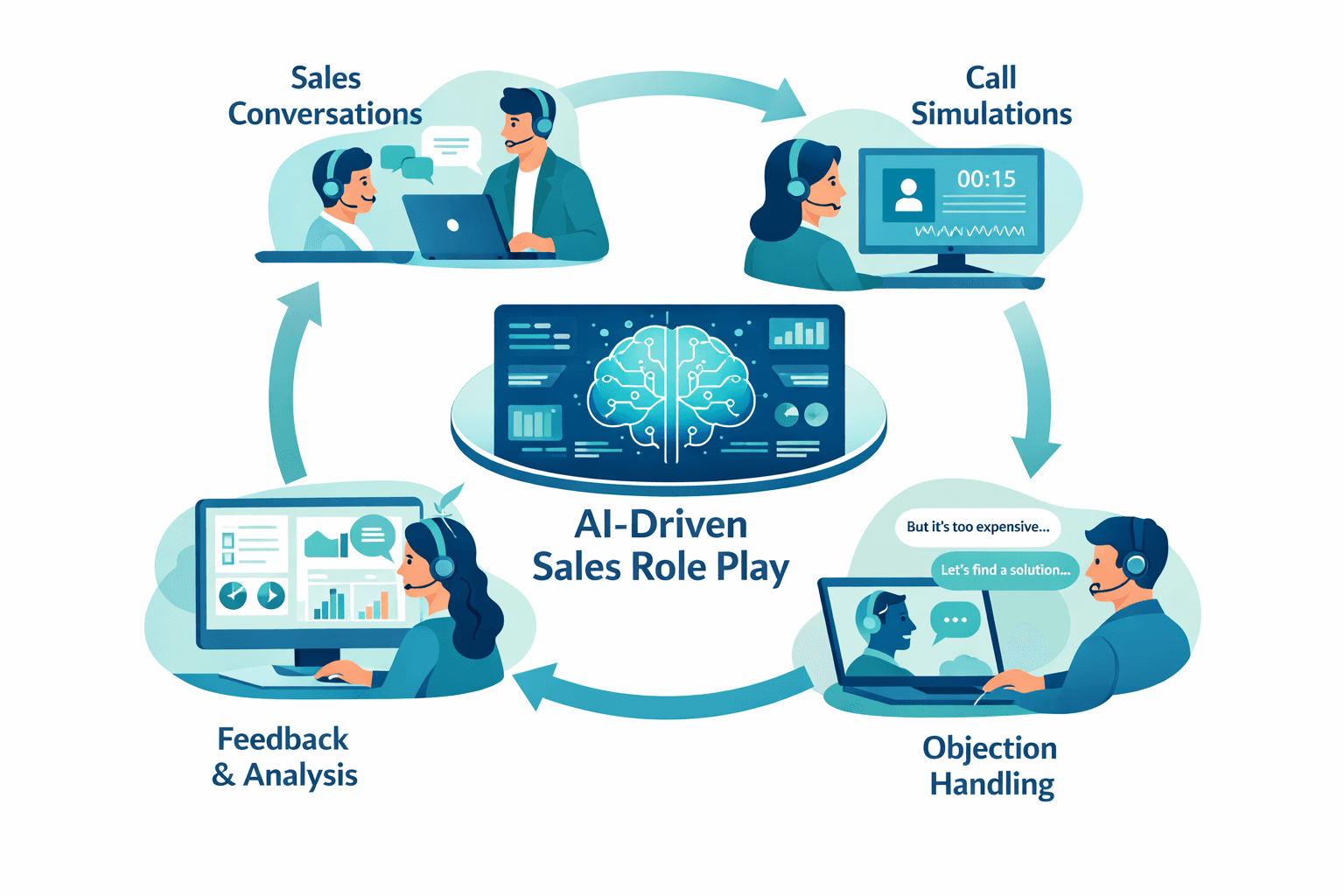
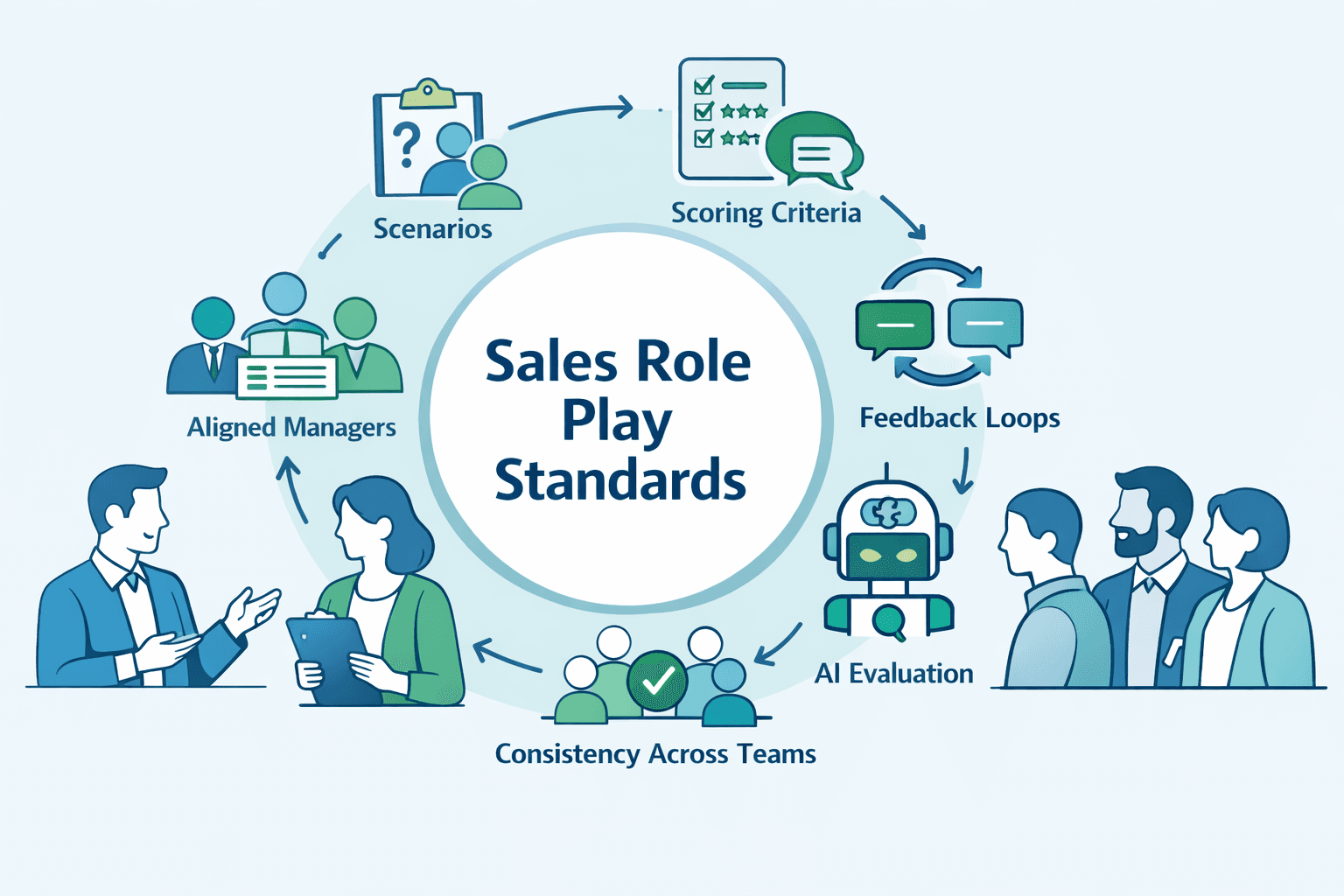
Modern sales enablement technology plays a critical role in standardizing role play across managers. AI-powered role play platforms allow organizations to create predefined scenarios aligned with buyer personas, deal stages, and product lines, ensuring every rep practices the same core situations regardless of who facilitates the session.
These tools enable consistent scoring frameworks, automated feedback, and performance benchmarks, reducing manager bias and subjectivity. Reps receive structured insights on talk ratio, objection handling, messaging clarity, and closing effectiveness, while managers gain actionable data to guide coaching conversations.
Additionally, technology makes role play scalable and repeatable. Recorded role play sessions allow leaders to audit coaching quality, share best-practice examples, and continuously refine standards. Integrated analytics help sales leaders identify trends, track improvement over time, and connect role play performance directly to deal outcomes—turning role play from a “soft skill exercise” into a measurable revenue driver.
Deep Dive: The Psychology Behind Effective Sales Role Play
Understanding the psychological drivers behind learning and performance is key to standardizing sales role play. Sales reps engage more deeply and improve faster when role play meets three core psychological needs: autonomy, competence, and psychological safety.
Autonomy: Reps perform better when role play allows room for personal selling style within a defined framework. Standardization should guide how role play is structured, not script every word, giving reps ownership over their approach.
Competence: Repeated practice with clear benchmarks builds confidence. Consistent scenarios and scoring criteria help reps understand what good performance looks like and track improvement over time.
Psychological Safety: Reps must feel safe to fail, experiment, and receive feedback. A standardized role play culture normalizes practice and reduces fear of judgment, especially when managers follow the same coaching norms.
Organizations that align role play with these principles see higher engagement and faster skill acquisition. For example, teams that use repeatable role play scenarios tied to real deals allow reps to practice meaningful conversations, reinforcing both competence and confidence while keeping motivation high.
Click on design structured sales role play scenarios for managers.
Measuring Sales Role Play Effectiveness: Key Metrics to Track
To ensure standardized role play delivers real business impact, sales leaders must track the right metrics. Without measurement, role play becomes a checkbox activity rather than a performance driver.
Role Play Participation Rate: Indicates how consistently managers and reps are using role play as part of coaching.
Skill Progression Scores: Tracks improvement in specific competencies such as discovery, objection handling, value messaging, and closing.
Manager Scoring Consistency: Highlights alignment (or gaps) in how different managers evaluate the same scenarios.
Time to Ramp: Measures how quickly new hires reach productivity after standardized role play is introduced.
Deal Performance Correlation: Connects role play outcomes to real metrics like win rate, deal size, and sales cycle length.
Feedback Quality: Assesses whether coaching feedback is specific, actionable, and aligned with defined standards.
By analyzing these metrics, sales leaders can identify coaching gaps, refine role play scenarios, and ensure standardization translates into measurable revenue impact. Over time, data-driven role play becomes a powerful lever for predictable performance and scalable sales excellence.
Click on apply AI-powered coaching to remove manager bias in feedback.
Conclusion
Standardizing sales role play across managers is no longer a “nice-to-have” coaching improvement—it’s a critical lever for consistent performance, faster ramp times, and predictable revenue growth. When role play is left to individual manager preferences, sales teams suffer from mixed messaging, uneven skill development, and subjective evaluations that erode trust and confidence.
A standardized approach creates a shared language of selling. It ensures every rep practices the same core scenarios, receives comparable feedback, and understands exactly what success looks like at each stage of the sales cycle. More importantly, it allows leaders to move from intuition-based coaching to data-backed enablement—where role play outcomes directly inform training priorities, coaching strategies, and pipeline decisions.
By combining clear frameworks, aligned manager expectations, supportive psychology, and the right technology, organizations can transform role play from an inconsistent activity into a repeatable system for skill mastery. In an increasingly competitive and distributed sales environment, standardizing sales role play is not about control—it’s about clarity, fairness, and unlocking the full potential of every seller.
Frequently Asked Questions
1. Why is it important to standardize sales role play across managers?
Standardization ensures consistent skill development, fair evaluations, and aligned expectations across the sales organization. It eliminates confusion caused by differing coaching styles and helps reps understand what “good performance” truly means.
2. Does standardizing role play reduce manager flexibility?
No. Effective standardization defines the structure, scenarios, and evaluation criteria while still allowing managers to personalize coaching and feedback based on individual rep needs.
3. What should be standardized in sales role play?
Key elements include role play scenarios, competencies being evaluated, scoring frameworks, feedback guidelines, and frequency of sessions. The goal is consistency without rigidity.
4. How often should standardized sales role play be conducted?
High-performing teams typically run role play weekly or bi-weekly, with additional sessions during onboarding, new product launches, or when performance gaps are identified.
5. Can standardized role play work for remote or hybrid sales teams?
Yes. In fact, standardization is even more important for remote teams. Virtual role play tools, recorded sessions, and shared scoring models help maintain coaching quality across locations.
6. What metrics should be used to measure role play effectiveness?
Common metrics include skill progression scores, manager scoring consistency, participation rates, time to ramp, and correlation between role play performance and real deal outcomes.
7. How does technology support standardized sales role play?
Technology enables predefined scenarios, consistent scoring, automated feedback, performance tracking, and coaching analytics—making role play scalable and measurable.
8. How long does it take to see results from standardized role play?
Most organizations see improvements in coaching consistency and rep confidence within weeks, with measurable gains in ramp time, win rates, and deal quality within a few months.
9. Who owns the standardization of sales role play?
Sales leadership typically defines the framework, sales enablement operationalizes it, and frontline managers execute it consistently through coaching sessions.
10. Is standardized role play suitable for experienced sales reps?
Yes. Advanced role play scenarios help experienced reps refine complex skills such as multi-stakeholder selling, negotiation, and enterprise deal management.
Learn more about


Try our AI Roleplay Bots for Free
Reduce Ramp-Up time by
47%
and double your sales productivity
Nikita Jain is a dynamic CEO and recognized leader passionate about harnessing technology and capability development to unlock the full potential of individuals and organizations. With over a decade of rich experience spanning enterprise learning, digital transformations, and strategic HR consulting at top firms like EY, PwC, and Korn Ferry, Nikita excels at driving significant, measurable success.