Sales Effectiveness

Maxim Dsouza

Introduction
For HR leaders, sales managers, and learning & development professionals, the need to build stronger, more adaptive teams has never been more urgent. Sales today looks dramatically different from just a few years ago—buyer expectations have evolved, digital-first communication has become standard, and purchase journeys now involve more stakeholders, more research, and more scrutiny. In this environment, traditional training approaches are no longer enough. Teams need continuous exposure to realistic sales role play scenarios that reflect the complexity of modern selling. The right sales scenarios help reps practice responses, refine judgment, and build confidence through structured repetition. Effective sales roleplay pushes reps beyond rehearsed scripts and equips them to navigate unpredictable conversations, layered objections, and shifting buyer priorities.
Click on Conversational AI for Sales: How It Works & Where It Helps Most
For HR leaders and managers responsible for designing development programs, the goal is not just to onboard new hires but to future-proof the entire sales organization. This requires integrating sales role play scenarios into a comprehensive learning strategy—one that reinforces adaptability, emotional intelligence, and situational awareness in every interaction. Through thoughtfully designed sales scenarios and ongoing sales roleplay practice, teams can strengthen critical thinking, enhance message consistency, and improve performance across all stages of the sales funnel.
This article dives deep into 12 high-impact sales role play scenarios that every modern sales professional should master. It also provides context, frameworks, and practical guidance to help HR leaders embed these sales scenarios into scalable training workflows. By leveraging the power of targeted sales roleplay, organizations can build sales teams that engage buyers with confidence, handle real objections effectively, and consistently deliver stronger outcomes.
Click on Inside Sales Training: A Complete Guide for Modern Teams
Why Sales Role Play Scenarios Matter More Than Ever
The traditional “shadow an experienced rep” training model has become increasingly outdated in today’s fast-changing commercial landscape. Modern sales cycles are longer, more complex, and far more dynamic than they once were, which means sales teams need continuous, structured, and measurable learning—not occasional exposure to isolated conversations. Organizations that integrate formalized learning methods, such as simulation-based training and well-designed sales role play scenarios, consistently outperform those relying on outdated methods. Multiple industry studies show that incorporating realistic sales scenarios into training drives substantial improvements, including higher quota attainment across experience levels, faster ramp-up times for new hires, stronger buyer engagement scores, and far more consistent messaging across distributed teams.
Click on Sales Coaching: How to Coach Reps Using AI-Driven Insights
The reason sales roleplay is so effective is simple: it mirrors the unpredictability and emotional intensity of real buyer interactions without any of the associated risks. Through practical sales role play scenarios, reps can experience objection pressure, decision fatigue, and unexpected conversational turns in a controlled and supportive environment. This allows managers and coaches to pinpoint skill gaps that may never appear in dashboards or reports but become obvious during targeted sales scenarios. These insights lead to sharper coaching, more confident reps, and smoother overall sales execution.
In markets where sales cycles stretch over months and involve multiple stakeholders—from finance to technical teams—the ability to respond quickly, adapt messaging, and think strategically becomes a true differentiator. Sales roleplay empowers reps to build this skill set long before they step into a real meeting. When teams regularly engage in high-fidelity sales role play scenarios, they develop the agility and confidence required to manage complex negotiations, handle resistance, and maintain control of the conversation. In such an environment, the ability to think on one’s feet isn’t just helpful—it becomes a measurable competitive advantage that directly influences outcomes.
Click on Sales Metrics & KPIs: What Every Manager Should Track in 2025
Why Many HR Leaders and Managers Fail to Implement Effective Sales Scenarios
Despite its importance, many organizations struggle to operationalize robust sales role play scenarios. Common reasons include:
1. Roleplay exercises feel unrealistic or overly scripted
When scenarios are outdated or generic, they fail to mirror the challenges reps actually face.
2. Managers lack time to design structured practice sessions
Sales leaders often prioritize pipeline over coaching.
3. Training sessions focus on pitch delivery, not situational decision-making
The result: reps can present well but cannot navigate objections or shifting buyer dynamics.
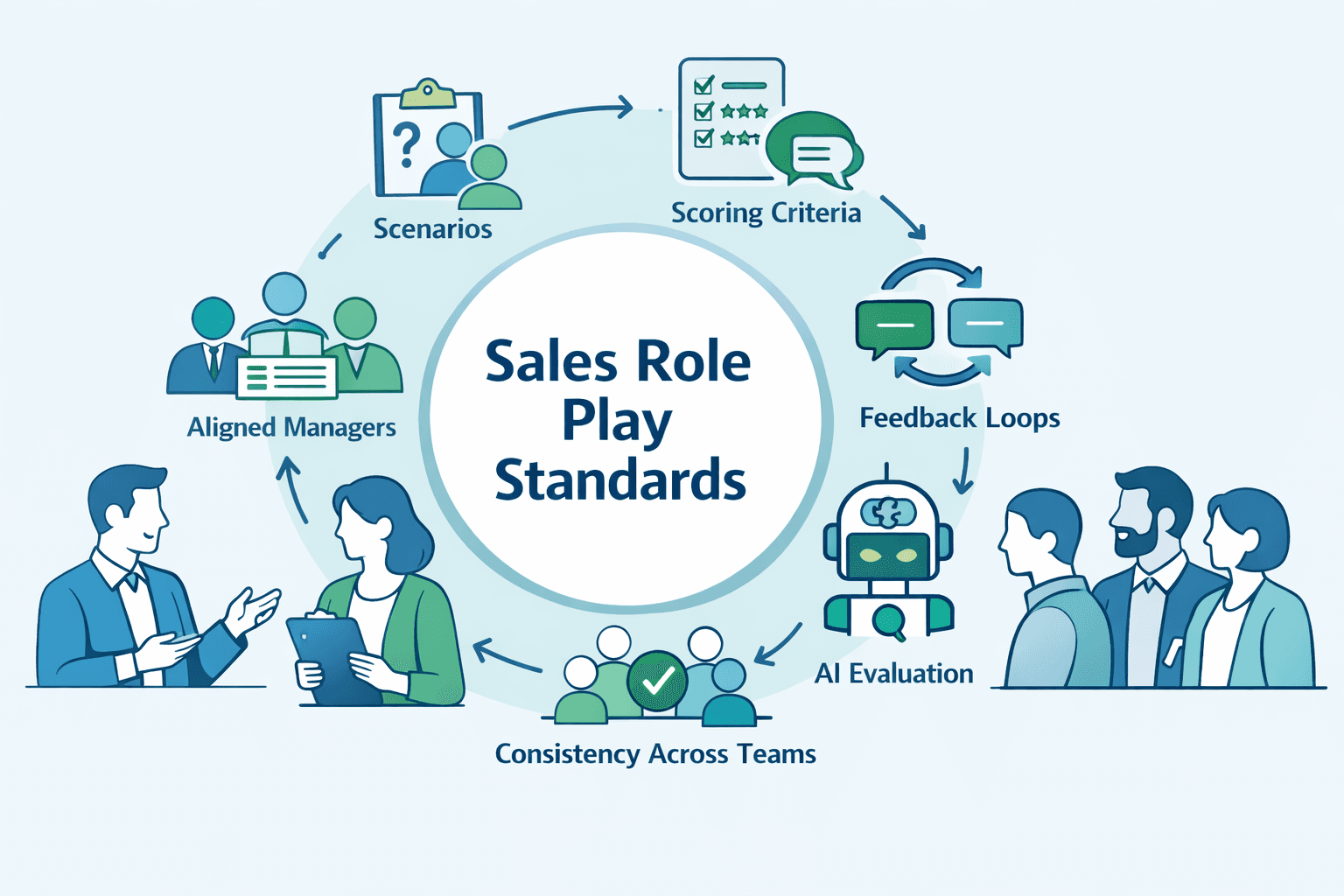
4. No standardized framework to evaluate performance
Without consistency, coaching becomes subjective rather than data-driven.
5. Lack of reinforcement mechanisms
Training done once a quarter results in minimal knowledge retention.
To solve this, HR and L&D teams must integrate sales scenarios into continuous learning, embed them within onboarding, and connect them to performance metrics.
Click on 4 Sales Strategy Mistakes To Avoid In Times Of Change
How to Determine When Sales Role Play Scenarios Are Necessary
While roleplay should be ongoing, certain organizational moments make it essential:
1. During onboarding or role transitions
New hires often struggle with internalizing value propositions. Practical simulations accelerate ramp-up.
2. When launching a new product or entering a new market
Reps need practice articulating new pricing, messaging, and competitive positioning.
3. When performance metrics show declining conversion rates
Scenario-based diagnosis reveals root causes behind pipeline leakages.
4. When feedback indicates inconsistent messaging
Roleplay helps align communication across teams.
5. When buyers’ objections shift due to market conditions
Economic downturns, new regulations, or competitor pivots require reps to adapt their responses.
Any time the sales message, buyer behavior, or competitive landscape evolves, sales roleplay ensures reps evolve with it.
12 Sales Role Play Scenarios Every Rep Should Practice
Below are the most essential sales scenarios for training modern reps. These scenarios align with challenges seen across industries—SaaS, consulting, B2B services, manufacturing, and more. Each scenario includes the context, training objective, rep skill focus, and prompts to include in LMS-based simulations.
1. The Cold Call Gatekeeper Scenario
Many deals never make it past the gatekeeper. This scenario focuses on handling receptionists, assistants, and screening managers.
Purpose: Teach reps to communicate value concisely and respectfully.
Skill focus: Brevity, confidence, rapport-building.
Simulation prompts:
Gatekeeper challenges the rep on purpose.
Asks “Is this a sales call?”
Requests an email instead of connecting the rep.
2. The Unresponsive Prospect in a Multi-Touch Cadence
Reps often assume silence means disinterest, but persistence—done right—drives conversions.
Purpose: Train reps to balance persistence with personalization.
Skill focus: Tone, creativity, sequencing.
Simulation prompts:
Prospect hasn’t responded after multiple touches.
Rep must craft a next-step interaction without sounding pushy.
3. The Price Objection Scenario
This is one of the most practiced sales role play scenarios because price objections appear in nearly every cycle.
Purpose: Equip reps to re-anchor value, not discount.
Skill focus: Discovery, ROI framing, negotiation.
Simulation prompts:
Prospect: “Your price is too high.”
Prospect compares your service with a cheaper competitor.
4. The “We’re Already Using a Competitor” Scenario
Reps must avoid attacking competitors and instead differentiate thoughtfully.
Purpose: Encourage value- and outcome-driven selling.
Skill focus: Positioning, insight selling.
Simulation prompts:
Prospect claims satisfaction with current solution.
Prospect asks: “Why should we switch?”
5. The Skeptical Technical Buyer Scenario
Technical stakeholders often challenge assumptions, timelines, and feasibility.
Purpose: Train reps to handle deeply technical questions with clarity.
Skill focus: Cross-functional communication, confidence.
Simulation prompts:
Technical buyer questions performance claims.
Requests in-depth explanation of integrations or compliance.
6. The Multi-Stakeholder Buying Committee Scenario
Modern B2B decisions involve many roles. Reps must adapt messaging per stakeholder.
Purpose: Develop stakeholder mapping and message tailoring.
Skill focus: Adaptability, executive communication.
Simulation prompts:
CFO focuses on cost-cutting.
User team wants ease of use.
Procurement challenges terms.
7. The Late-Stage Stall Scenario
Sometimes deals go cold right when the finish line feels close.
Purpose: Teach reps to re-surface urgency with respect.
Skill focus: Reframing, timeline management.
Simulation prompts:
Prospect stops responding after verbal agreement.
Stakeholder keeps delaying final approval.
8. The Difficult Personality Scenario
Some buyers are terse, impatient, or dismissive.
Purpose: Improve emotional intelligence and composure under pressure.
Skill focus: Active listening, empathy, regulation.
Simulation prompts:
Buyer interrupts or challenges the rep repeatedly.
Buyer dismisses product features prematurely.
9. The Discovery Call That Goes Off-Track
Discovery conversations often drift. Reps must course-correct without friction.
Purpose: Strengthen qualification and questioning strategy.
Skill focus: Guiding conversations, eliminating ambiguity.
Simulation prompts:
Buyer talks about irrelevant issues.
Rep must redirect gracefully while maintaining rapport.
10. The Renewal-at-Risk Scenario
Customer retention requires proactive communication.
Purpose: Enable account managers to identify churn signals early.
Skill focus: Relationship management, value reinforcement.
Simulation prompts:
Customer complains about service quality.
Customer hints at exploring alternatives.
11. The Upsell/Cross-sell Scenario
Not all reps are comfortable expanding accounts.
Purpose: Teach reps to spot expansion opportunities ethically.
Skill focus: Timing, confidence, solution framing.
Simulation prompts:
Customer is satisfied but not actively seeking new features.
Rep must position complementary products.
12. The Procurement Negotiation Scenario
Procurement negotiators are trained to push hard.
Purpose: Prepare reps to negotiate without unnecessary concessions.
Skill focus: Negotiation strategy, boundary-setting.
Simulation prompts:
Buyer demands discounts.
Buyer requests contract term changes.
Conclusion
High-performing organizations understand that relying solely on CRM dashboards, monthly reviews, or post-call analysis is no longer enough to develop a world-class sales team. Instead, they invest in building high-fidelity, continuous sales role play scenarios that become an integral part of their broader learning ecosystem. These carefully crafted sales scenarios allow reps to practice handling real buyer behaviors, navigate layered and complex objections, manage pressure-heavy situations, and refine their communication skills in a safe, controlled space. Through consistent sales roleplay, teams strengthen their ability to respond with clarity, empathy, and confidence—traits essential in today’s unpredictable selling environment.
For HR leaders, sales managers, and L&D professionals, the roadmap to building a stronger, more resilient sales organization is unmistakably clear: prioritize structured, realistic sales role play scenarios and embed these sales scenarios into daily, weekly, and monthly training workflows. When sales roleplay becomes routine rather than occasional, it transforms learning into a continuous performance accelerator.
Integrating these sales role play scenarios deeply into training not only strengthens core skills but also fosters adaptability, sharper decision-making, and more consistent messaging across the team. Reps learn to think on their feet, communicate with conviction, and pivot smoothly based on buyer cues. Ultimately, organizations that commit to ongoing sales scenarios and rigorous sales roleplay build teams that stay composed, remain proactive, and consistently convert conversations into measurable revenue outcomes.
Click on How to Be Successful in Sales: Skills Every Rep Needs Today
FAQ: Sales Role Play Scenarios for HR Leaders and Sales Managers
1. What are sales role play scenarios?
Sales role play scenarios are structured training exercises that simulate real-world selling situations. These sales scenarios allow reps to practice objection handling, communication skills, and decision-making in a controlled environment. Sales roleplay helps teams build confidence before they interact with actual buyers.
2. Why are sales role play scenarios important for modern sales teams?
Sales cycles today are more complex, and buyers expect highly personalized interactions. Sales role play scenarios allow reps to rehearse difficult conversations, test different approaches, and strengthen core selling skills. Effective sales roleplay improves adaptability, emotional intelligence, and the ability to think under pressure.
3. How often should teams practice sales scenarios?
High-performing organizations integrate sales role play scenarios into weekly or bi-weekly coaching sessions. Consistent sales roleplay ensures that skills are reinforced regularly and that reps stay prepared for evolving buyer challenges.
4. Who should participate in sales roleplay sessions?
Everyone involved in the selling process benefits—new hires, experienced reps, account managers, SDRs, and even cross-functional partners like product specialists. Sales scenarios help all roles communicate more clearly and consistently.
5. How can HR leaders incorporate sales role play scenarios into an LMS?
HR leaders can upload branching simulations, role-based scripts, video prompts, and assessment rubrics into an LMS. This makes sales roleplay scalable, trackable, and repeatable. Reps can complete sales scenarios independently and receive automated or manager-provided feedback.
6. What types of sales scenarios are most effective?
High-impact sales role play scenarios typically include cold calls, price objections, competitor comparisons, multi-stakeholder meetings, stalled deals, discovery calls, and renewal challenges. These sales scenarios mirror real buyer interactions and strengthen situational judgment.
Reference List
The Business Case for Sales Training — ATD Blog (based on CSO Insights data)
https://www.td.org/content/atd-blog/the-business-case-for-sales-trainingBoosting Sales Team Training with an LMS — Opigno (on training investments and win rates)
https://www.opigno.org/blog/boosting-sales-team-training-lmsWhat Is Sales Enablement? The CSO’s Ultimate Guide — Gartner
https://www.gartner.com/en/sales/topics/sales-enablementThe Role of Technology in Sales Training and Sales Enablement — TheLearningOS
https://www.thelearningos.com/enterprise-knowledge/the-role-of-technology-in-sales-training-and-sales-enablementCSO Insights 2016 Sales Enablement Optimization Study (PDF)
https://learn.seismic.com/rs/217-LXS-149/images/2016_CSO_Insights_Sales_Enablement_Optimization_Study.pdfCSO Insights 2016 Sales Enablement Optimization Study summary — Brainshark (PDF)
https://www.brainshark.com/sites/default/files/cso-insights-2016-sales-enablement-optimization-study.pdf
Learn more about


Try our AI Roleplay Bots for Free
Reduce Ramp-Up time by
47%
and double your sales productivity
Maxim Dsouza is the Chief Technology Officer at Eubrics, where he drives technology strategy and leads a 15‑person engineering team. Eubrics is an AI productivity and performance platform that empowers organizations to boost efficiency, measure impact, and accelerate growth. With 16 years of experience in engineering leadership, AI/ML, systems architecture, team building, and project management, Maxim has built and scaled high‑performing technology organizations across startups and Fortune‑100. From 2010 to 2016, he co‑founded and served as CTO of InoVVorX—an IoT‑automation startup—where he led a 40‑person engineering team. Between 2016 and 2022, he was Engineering Head at Apple for Strategic Data Solutions, overseeing a cross‑functional group of approximately 80–100 engineers.