Sales Effectiveness

Nikita Jain

Introduction
Inside sales has become the dominant engine of B2B revenue growth, and in 2025 its importance is only increasing. Buyers now prefer remote, digital-first interactions, often completing the majority of their research before ever engaging with a sales representative. According to multiple industry studies, modern buyers expect sales conversations to be contextual, insightful, and value-driven from the very first touchpoint. In this environment, inside sales teams are no longer just qualifying leads or running scripted calls—they are responsible for guiding complex buying decisions and influencing revenue outcomes early in the funnel.
This shift has placed unprecedented pressure on sales leaders, enablement heads, founders, CROs, revenue operations leaders, and B2B sales managers. Inside sales teams are expected to ramp faster, handle higher volumes of conversations, and perform consistently across channels such as phone, email, video, and chat. At the same time, teams are often leaner, distributed, and operating under tighter performance expectations. As a result, traditional inside sales training models are struggling to keep up.
For years, inside sales training focused on onboarding programs, call scripts, and periodic product or process updates. While these approaches helped establish baseline knowledge, they rarely prepared reps for the reality of live buyer conversations. New hires often knew what to say in theory but struggled to adapt when buyers asked unexpected questions, raised objections, or involved multiple stakeholders. This gap between knowledge and execution led to long ramp times, inconsistent performance, and missed revenue opportunities.Organizations increasingly rely on structured visibility tools such as an employee performance tracker for modern teams to identify these execution gaps early.
In 2025, that gap is no longer acceptable. Inside sales training must evolve from a one-time onboarding activity into a continuous, performance-driven enablement system. Training alone is not enough. Inside sales teams need structured practice, ongoing coaching, real-time feedback, and reinforcement that aligns directly with how buyers actually behave. This is where modern enablement programs, powered by data and AI, are reshaping how inside sales organizations develop talent.
At the same time, many organizations are still unclear about the difference between sales enablement vs sales training. Training focuses on transferring information, while enablement focuses on improving execution over time. In high-velocity inside sales environments, this distinction matters deeply. Small improvements in discovery quality, objection handling, or value articulation can compound quickly across thousands of conversations.
This playbook is designed to help inside sales leaders navigate that shift. It provides a practical, future-focused view of inside sales training in 2025, explains how enablement programs should be structured for inside sales teams, and outlines how modern organizations are building scalable systems that drive consistency, speed, and predictable revenue. By rethinking inside sales training as an ongoing capability-building discipline, leaders can better equip their teams to meet the demands of today’s buyers and tomorrow’s market.
Sales Enablement vs Sales Training for Inside Sales Teams
One of the biggest challenges inside sales leaders face in 2025 is not a lack of effort or investment, but a lack of clarity around sales enablement vs sales training. These terms are often used interchangeably, yet they represent two very different approaches to developing inside sales performance. Understanding this distinction is critical, especially in high-velocity inside sales environments where small execution gaps can quickly scale into major revenue problems.
Sales Training Focuses on Knowledge Transfer
Sales training traditionally focuses on knowledge transfer. Inside sales reps are trained on product features, pricing, buyer personas, qualification frameworks, CRM processes, and call scripts. This training usually happens during onboarding or in periodic sessions such as quarterly kickoffs, certifications, or product launches. Training answers the question of what a rep should know. While this foundation is necessary, it is rarely sufficient on its own. Inside sales reps operate in fast-paced, unpredictable conversations where knowing information does not automatically translate into using it effectively.Many organizations support this knowledge delivery through structured platforms such as a SCORM compliant LMS for scalable training programs.
Sales Enablement Focuses on Execution Over Time
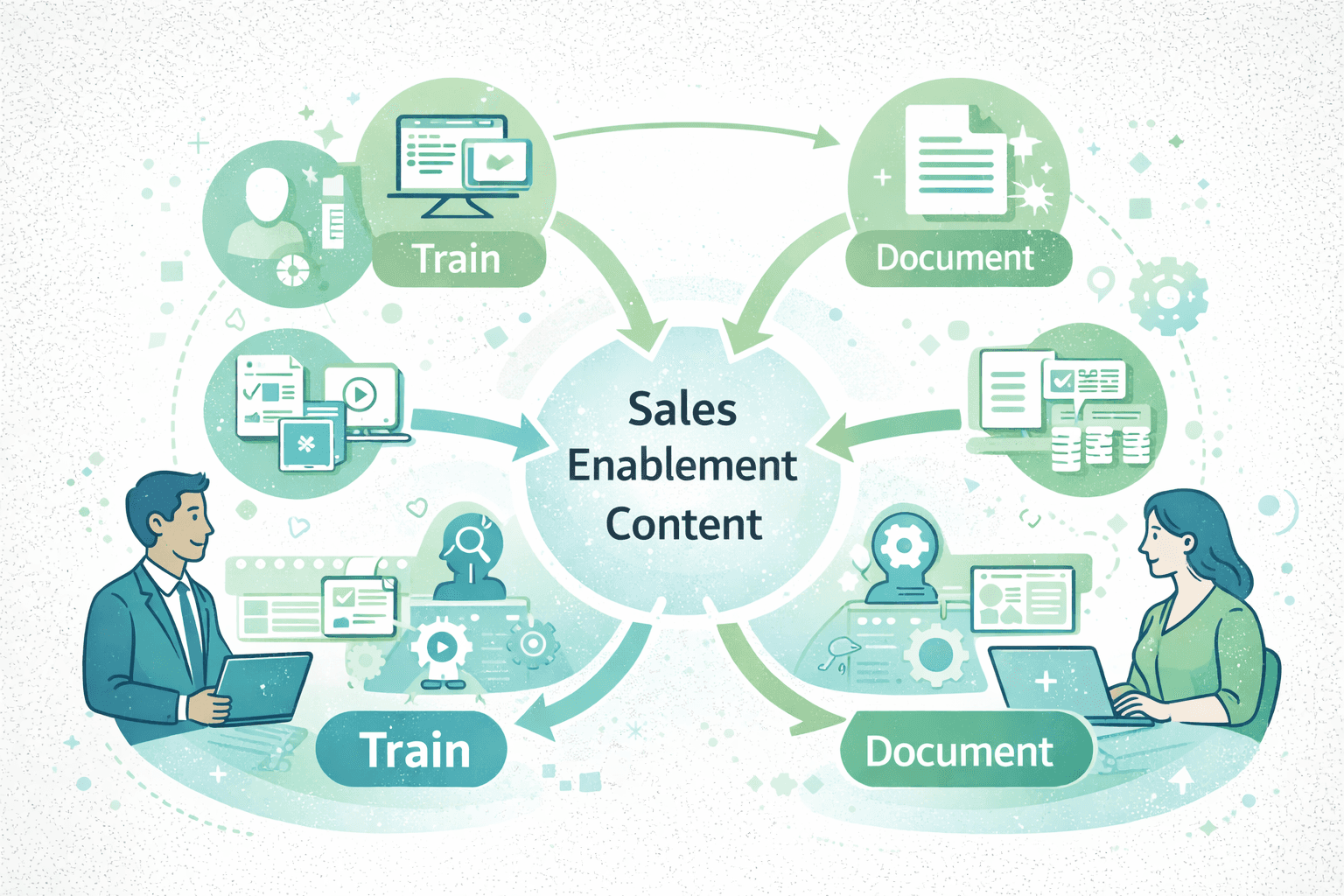
Sales enablement, on the other hand, is designed to improve execution over time. An enablement program focuses on how inside sales reps behave in real conversations, how managers coach them day to day, and how skills are reinforced consistently across the funnel. Enablement answers the question of how reps should perform in live selling situations. This includes not just initial training, but ongoing coaching, practice, feedback, content application, and performance measurement.
Why the Difference Matters in Inside Sales
The difference becomes especially important in inside sales teams because of volume and speed. Inside reps may handle dozens of conversations in a single day. If discovery questions are weak, value is poorly articulated, or objections are mishandled, those issues repeat at scale. Traditional training might tell a rep what good discovery looks like, but enablement ensures they can actually execute it consistently under pressure.
In many organizations, inside sales training is treated as a one-time event, while enablement is treated as a support function. In 2025, high-performing teams flip this model. Training becomes one component within a broader enablement program that continuously develops skills. Reps are trained, but they are also coached, observed, given feedback, and asked to practice in realistic scenarios. Managers play a central role, supported by data and insights that help them focus on the behaviors that matter most.
Measuring Enablement vs Training Success
Another key difference between sales enablement vs sales training lies in measurement. Training success is often measured by completion rates, certifications, or attendance. Enablement success is measured by outcomes such as ramp time, conversion rates, deal velocity, win rates, and consistency of performance across reps.For inside sales leaders, these are the metrics that directly impact revenue predictability and overall ways to improve work performance in organizations.
In 2025, inside sales organizations that rely only on training will continue to struggle with inconsistent execution. Those that invest in a structured enablement program—where training, coaching, practice, and measurement work together—will be far better positioned to scale performance, adapt to buyer expectations, and drive sustainable growth.
Inside Sales Training Framework for 2025
To build high-performing inside sales teams in 2025, leaders must move beyond fragmented training efforts and adopt a structured, repeatable framework. Inside sales training today must operate as a continuous system that aligns directly with execution, coaching, and revenue outcomes. The following steps outline how modern organizations design inside sales training for scale and consistency.
1. Align Inside Sales Training With Business Outcomes
The first step is ensuring that inside sales training is directly aligned with measurable business objectives. Training should support outcomes such as higher lead-to-opportunity conversion rates, shorter sales cycles, faster ramp time, and improved forecast accuracy. When training initiatives are tied to these outcomes, leaders can clearly prioritize which skills matter most and justify ongoing investment. Without outcome alignment, inside sales training often becomes activity-focused rather than performance-driven.
2. Design Role-Specific Training Paths
Inside sales teams include multiple roles, each requiring a distinct set of skills. SDRs and BDRs focus heavily on prospecting, qualification, and opening conversations, while inside account executives must master discovery, value articulation, objection handling, and closing. The second step is designing role-specific inside sales training paths that reflect these differences. Tailored learning ensures relevance, accelerates skill development, and prevents reps from being overwhelmed with unnecessary content.
3. Embed Continuous Practice and Skill Reinforcement
The third step is embedding regular practice into the training framework. Knowledge alone does not translate into consistent execution, especially in high-velocity inside sales environments. Reps need repeated opportunities to apply what they learn in realistic scenarios. Continuous practice helps sellers internalize messaging, respond more confidently to objections, and adapt to buyer signals. Over time, this reinforcement turns learned skills into habits that hold up under pressure.Gamification increasingly plays a role here, supported by platforms such as a gamified LMS for employee engagement and skill development.
4. Enable Manager-Led Coaching as a Core Component
The fourth step is making coaching a central part of inside sales training. Frontline managers have the greatest influence on rep performance, yet many lack the structure or insights needed to coach effectively. A strong training framework supports managers with clear coaching priorities, consistent feedback loops, and visibility into rep performance. Training and coaching should work together, ensuring that what reps learn is reinforced through regular, focused coaching conversations.
5. Measure Impact and Continuously Improve the Program
The final step is measuring the impact of inside sales training and using those insights to continuously improve the program. Leaders should track metrics such as ramp time, conversion rates, deal quality, win rates, and consistency across reps. These metrics reveal whether training is driving meaningful behavior change and business results. By reviewing performance data regularly, organizations can refine training content, adjust coaching focus, and keep the enablement program aligned with evolving buyer expectations and broader ways to improve productivity in the workplace.
How AI Is Transforming Inside Sales Training and Enablement Programs
AI is fundamentally reshaping how inside sales training is delivered and measured. Instead of relying on intuition or anecdotal feedback, organizations can now use AI to analyze calls, emails, and CRM activity to identify real performance gaps.
Modern AI-driven enablement programs analyze inside sales conversations to assess factors such as question quality, talk-to-listen ratios, objection handling effectiveness, and value articulation. These insights allow enablement teams to design targeted training interventions rather than generic programs.
Sales training simulations powered by AI allow inside reps to practice realistic scenarios, including cold calls, discovery conversations, pricing discussions, and renewal negotiations. Unlike traditional roleplay, AI simulations provide objective, consistent feedback and can be repeated as often as needed.
AI also enables personalization at scale. Two inside sales reps in the same role may receive entirely different training paths based on their individual strengths and weaknesses. This increases engagement, accelerates skill development, and improves consistency across the team.
Conclusion
Looking ahead, inside sales training will become increasingly predictive, personalized, and embedded into daily workflows. Enablement programs will shift from reactive training to proactive capability building, with AI recommending practice scenarios based on live pipeline data and upcoming deals.
The line between sales enablement vs sales training will continue to blur as organizations adopt continuous enablement models. Inside sales reps will receive real-time guidance during calls, contextual content recommendations, and ongoing feedback loops that support execution in the moment.
Organizations that invest early in modern inside sales training and enablement programs will be better positioned to scale efficiently, adapt to buyer expectations, and drive predictable revenue growth in increasingly competitive markets.
FAQs
What is inside sales training and why is it important in 2025?
Inside sales training focuses on developing the skills required for remote selling, including discovery, qualification, objection handling, and value articulation. In 2025, it is critical because buyers expect high-quality conversations early in the buying journey.How is sales enablement vs sales training different for inside sales teams?
Sales training focuses on knowledge transfer, while sales enablement provides continuous coaching, practice, and reinforcement to improve execution in real conversations.What should a modern enablement program include for inside sales?
A modern enablement program includes role-specific training, AI-powered practice, manager-led coaching, performance analytics, and continuous reinforcement.Can AI improve inside sales training effectiveness?
Yes. AI improves inside sales training by identifying real performance gaps, personalizing learning paths, and enabling scalable practice through simulations.How do sales training simulations help inside sales reps?
Sales training simulations allow reps to practice realistic scenarios safely, build confidence, and receive objective feedback before engaging real buyers.Who owns inside sales training in an organization?
Ownership typically sits with enablement or revenue operations teams, in close collaboration with sales leadership and frontline managers.How long does it take to see results from inside sales training?
Organizations often see early improvements in confidence and execution within weeks, with measurable revenue impact following over several months.What metrics matter most for inside sales enablement?
Key metrics include ramp time, conversion rates, deal velocity, win rates, and consistency of seller behavior.How does AI support manager coaching in inside sales teams?
AI surfaces actionable insights from calls and activity data, helping managers focus coaching on the behaviors that matter most.How will inside sales training evolve in the future?
Inside sales training will become more predictive, personalized, and embedded into daily workflows through AI-driven enablement systems.
References
Inside Sales: A Complete Guide (Process, Tools & Tips) — Leadsquared’s comprehensive explanation of inside sales fundamentals, team building, and strategies relevant to training and performance. LeadSquared
Successfully Implementing an Inside Sales Strategy — MarketStar’s extensive guide covering digital-age inside sales strategies and best practices for enabling inside sales teams. marketstar.com
Inside Sales Tips to Grow Your Sales Pipeline in 2025 — Veloxy’s list of actionable inside sales practices and skills that can inform training priorities and techniques. Veloxy
Inside Sales: Your Ultimate Guide to Beat the Competition — NeoDove’s detailed inside sales overview, team structure, roles, and training-related insights for modern inside sales operations. neodove.com
The 4 Pillars of Sales Training — DealHub’s exploration of core principles and frameworks for effective sales training, including readiness, measurement, and technology use. DealHub
Learn more about


Try our AI Roleplay Bots for Free
Reduce Ramp-Up time by
47%
and double your sales productivity
Nikita Jain is a dynamic CEO and recognized leader passionate about harnessing technology and capability development to unlock the full potential of individuals and organizations. With over a decade of rich experience spanning enterprise learning, digital transformations, and strategic HR consulting at top firms like EY, PwC, and Korn Ferry, Nikita excels at driving significant, measurable success.