
Manufacturing firm boosts shopfloor problem-solving with structured capability development—achieving 83% completion, improved decision-making, and stronger operational execution through real-world learning.
Strengthening structured thinking and execution across operational teams
Manufacturing environments require employees to make quick, effective decisions while managing complex operational challenges. From addressing production issues to coordinating across teams, employees frequently encounter situations that demand structured problem-solving and clear execution.
A mid-sized manufacturing organization recognized that while employees possessed strong technical expertise, there was an opportunity to strengthen how teams approached problem analysis, planning, and decision-making on the shopfloor.
Many operational challenges were often addressed reactively rather than through structured frameworks, which sometimes led to recurring issues or inefficiencies. Additionally, traditional training programs did not always translate into consistent behavioral change during day-to-day work.
The organization wanted to create a learning system that would not only build capability but also help employees apply structured thinking directly within real operational scenarios.
To address this need, the company introduced a structured capability development initiative designed to strengthen problem-solving, execution, and workplace decision-making through practical learning and real-world application.
The initiative focused on strengthening operational capability while ensuring that learning translated into tangible improvements in workplace behavior.
The organization aimed to:
Strengthen employees’ ability to approach operational challenges with structured problem-solving frameworks
Improve planning, prioritization, and execution across daily work activities
Reduce recurring operational issues by encouraging root-cause thinking
Build stronger communication and coordination across teams
Introduce measurable visibility into learning engagement and skill development
At the same time, the organization wanted to establish a scalable framework that would continuously reinforce workplace capability rather than relying on one-time training programs.
To move beyond traditional training formats, the organization introduced Eubrics to build a structured capability development journey designed to connect learning with everyday workplace challenges.
Structured Learning Focused on Workplace Problem-Solving
Employees participated in curated learning modules designed to strengthen core workplace capabilities such as problem-solving, planning, prioritization, communication, and execution. The content reflected real operational scenarios employees encountered in their daily work.
Habit-Based Reinforcement for Behavioral Application
Participants reinforced their learning through habit-based activities that encouraged them to apply structured frameworks while solving real shopfloor challenges and making daily work decisions.
Learning Integrated Into Real Job Moments
Instead of separating training from work, the initiative encouraged employees to apply learning directly during operational challenges, team coordination, and everyday decision-making moments.
Visibility Through Continuous Progress Tracking
The program also provided managers with visibility into participation, learning progress, and skill performance. This helped ensure that capability development translated into meaningful workplace outcomes.
Together, these elements helped transform training into an ongoing system that reinforced capability development through everyday work experiences.
Program Participation
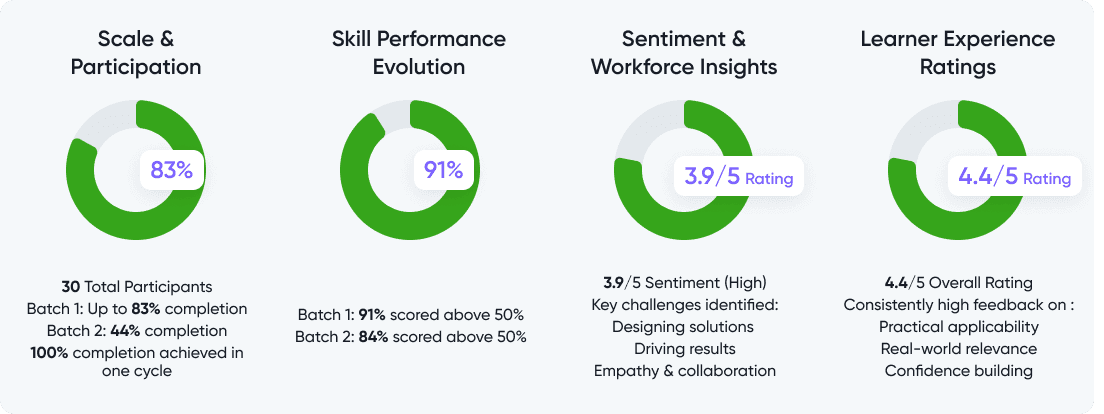
The initiative engaged 30 employees across operational teams, creating strong participation throughout the structured learning journey.
Completion rates reached up to 83%, demonstrating consistent engagement as employees progressed through capability-building modules.
Knowledge & Skill Progress
Participants demonstrated strong comprehension of key workplace concepts, including structured problem-solving, planning, and execution frameworks.
Assessment results indicated that employees were able to understand and apply these concepts effectively in practical operational scenarios.
Learner Experience
Participants reported a highly positive learning experience, with overall program ratings reaching up to 4.4 out of 5.
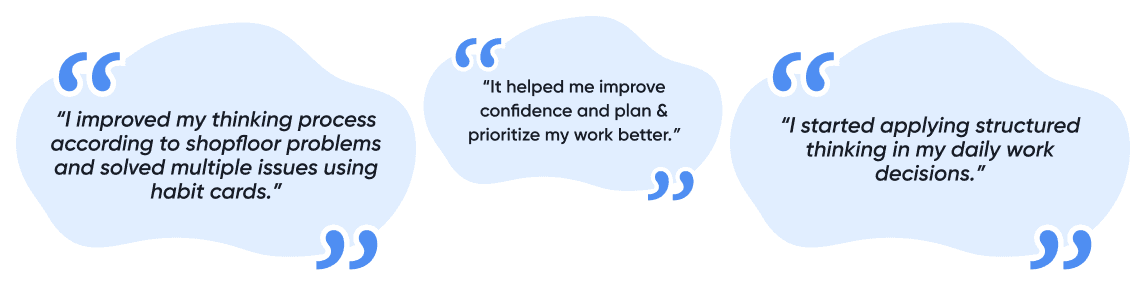
Learners highlighted the practical nature of the program and its direct relevance to everyday work situations. Many employees reported improvements in confidence, clarity of thinking, and their ability to approach workplace problems more systematically.
Over time, the initiative began influencing how employees approached operational challenges and workplace decisions.
Employees started applying structured problem-solving frameworks when analyzing shopfloor issues
Planning and prioritization improved across daily operational activities
Teams demonstrated stronger confidence in decision-making and execution
Managers gained better visibility into capability development and engagement
Across the program, employees completed 450+ workplace actions, demonstrating clear evidence that learning was actively applied to real operational situations.
Area | Before | With Eubrics |
Problem-Solving Approach | Ad-hoc handling | Structured frameworks |
Workplace Application | Limited | 450+ job actions applied |
Engagement | Inconsistent participation | Higher structured engagement |
Skill Visibility | No clear insights | Assessment-driven clarity |
Learning Adoption | One-time training | Continuous habit-based learning |
This initiative demonstrates how manufacturing organizations can strengthen operational capability by connecting learning directly with real workplace situations.
By combining structured learning modules, habit-based reinforcement, and practical application, the organization enabled employees to develop stronger problem-solving and execution capabilities within their daily work environment.
The program created a framework where learning continuously influenced workplace behavior, helping employees approach operational challenges with greater clarity, confidence, and structured thinking.