
Real estate advisory firm case study in India showcasing how an assessment-led capability development program improved communication, empathy, and workplace effectiveness—achieving 62.5% completion, 4.5/5 ratings, and measurable performance impact.
Building stronger communication, empathy, and workplace effectiveness
In client-facing industries like real estate advisory, success depends heavily on how effectively teams communicate, build relationships, and manage day-to-day execution. From handling client interactions to coordinating internally, employees are required to demonstrate clarity, empathy, and structured decision-making in every engagement.
A real estate advisory firm identified an opportunity to strengthen these capabilities across its workforce. While employees were actively engaged in their roles, there was limited visibility into individual strengths and development areas across key competencies such as communication, collaboration, and execution.
At the same time, inconsistencies in communication, relationship management, and decision-making were impacting overall workplace effectiveness. Traditional learning approaches were not consistently translating into behavioral change, making it difficult to drive sustained improvement.
The organization needed a structured system that could identify capability gaps, deliver targeted development, and ensure that learning translated into real workplace application.
To address this, the company introduced an assessment-led capability development initiative focused on building communication, empathy, and execution through structured learning and real-world application.
The initiative focused on strengthening workplace effectiveness while ensuring learning translated into consistent behavioral improvement.
The organization aimed to:
Improve communication clarity and relationship-building capabilities
Strengthen empathy and collaboration across teams
Build structured decision-making and execution skills
Enable employees to better manage tasks and deliver results effectively
Introduce visibility into individual strengths, gaps, and development progress
At the same time, the organization wanted to create a continuous learning system that could drive sustained behavioral change rather than one-time skill development.
To enable targeted capability development and real-world application, the organization introduced a structured, assessment-led learning journey.
Assessment-Led Capability Identification
Employees underwent structured assessments to identify strengths and development areas across key competencies. This created clear visibility into individual capability gaps and helped define personalized development pathways.
Targeted Learning Journeys for Core Skills
Based on assessment insights, employees were enrolled in focused learning journeys covering communication, collaboration, leadership, and workplace effectiveness. The content was designed to address real challenges employees faced in their day-to-day roles.
Real-World Application Through Job Actions
Participants applied their learning through structured on-the-job activities, enabling them to practice new skills in real workplace scenarios. This ensured that learning moved beyond theory and translated into actionable behavior.
Continuous Feedback and Reinforcement
The program incorporated ongoing feedback, structured tracking, and reinforcement mechanisms. This helped employees stay engaged while ensuring consistent progress and application of learning over time.
Together, these elements created a system where assessment, learning, and application were closely linked to drive meaningful capability development.
Program Participation
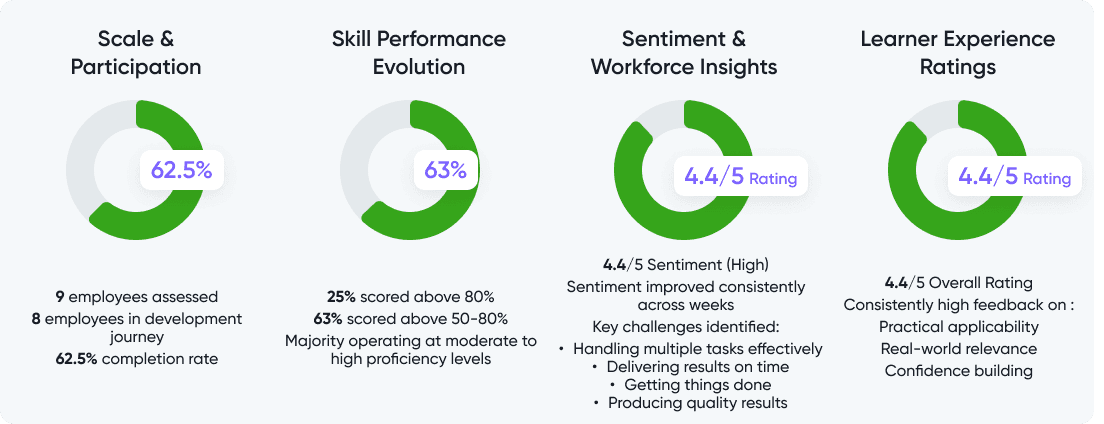
The initiative saw steady participation across employees, with a 62.5% completion rate, reflecting consistent engagement in structured learning journeys.
Employees actively progressed through development modules focused on improving communication, collaboration, and workplace effectiveness.
Knowledge & Skill Progress
Assessment insights indicated that employees were operating across moderate to high proficiency levels, with clear improvement in core workplace capabilities such as communication, structured thinking, and execution.
The program enabled employees to better understand their strengths and areas for development, creating a strong foundation for continuous growth.
Learner Experience
Participants reported a highly positive learning experience, with overall program ratings reaching 4.5 out of 5 and sentiment scores at 4.4 out of 5.
Learners highlighted the practical applicability of the program, its relevance to real work scenarios, and its impact on confidence and day-to-day effectiveness.
Over time, the initiative began influencing how employees approached workplace interactions and daily execution.
Employees developed stronger self-awareness through structured assessments
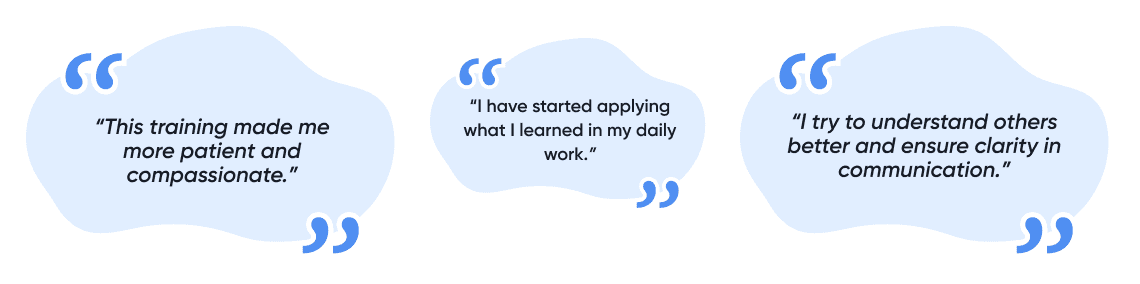
Communication clarity and empathy improved across client and internal interactions
Decision-making and structured thinking became more consistent
Employees demonstrated improved ability to manage tasks and deliver results
Learning was actively applied in real work scenarios, strengthening workplace effectiveness
The program also enabled a clear shift from traditional training to a system where learning continuously influenced behavior and performance.
Area | Before | With Eubrics |
Capability Visibility | Limited understanding | Assessment-driven clarity |
Communication Skills | Inconsistent | Structured improvement |
Workplace Application | Minimal | 126 job actions applied |
Engagement | Moderate | High sentiment & participation |
Learning Approach | Generic | Personalized journeys |
Development Tracking | Absent | Continuous measurement |
This initiative demonstrates how organizations can strengthen workplace effectiveness by combining assessment-led insights with structured learning and real-world application.
By identifying capability gaps, delivering targeted development journeys, and reinforcing learning through on-the-job application, the organization enabled employees to improve communication, empathy, and execution in their daily roles.
The program created a scalable, data-driven framework where learning continuously translated into behavior, helping drive sustained performance improvement across the workforce.