
A large manufacturing enterprise strengthened analytical problem-solving across 5,000+ employees through a structured capability development initiative. Using guided learning journeys, habit-based practice, and real workplace application, employees learned to identify root causes, apply structured decision-making frameworks, and solve operational challenges more systematically. The program achieved 100% completion and strong learner engagement.
Strengthening analytical thinking across the workforce
A large manufacturing enterprise introduced a capability-building initiative to strengthen analytical problem-solving and structured decision-making across its workforce. As the organization continued to focus on operational efficiency and process improvement, leadership recognized the importance of equipping employees with stronger analytical frameworks that could be applied directly to everyday work situations.
Traditional training programs had helped employees gain exposure to analytical concepts, but learning often remained theoretical and disconnected from real operational challenges. Many employees struggled to consistently apply structured problem-solving approaches when addressing recurring issues in the workplace.
The organization needed a learning system that could move beyond knowledge transfer and enable employees to practice analytical thinking in real work contexts while reinforcing these behaviors over time.
To address this, the company introduced a structured digital learning initiative that combined guided learning journeys, habit-based application, and continuous engagement tracking to build practical analytical capabilities across teams.
The initiative focused on strengthening employees’ analytical thinking and problem-solving capabilities while ensuring learning translated into real workplace application.
The organization aimed to:
Improve employees’ ability to identify root causes behind operational issues
Encourage structured problem-solving and better decision-making across teams
Create a learning environment that reinforced analytical thinking in everyday work situations
Introduce a system that could track engagement and learning progress over time
At the same time, leadership wanted a model that could reinforce capability development continuously rather than relying solely on isolated training sessions.
To move beyond traditional training formats, the organization introduced a structured development experience through the Eubrics platform focused on real-world application and continuous skill reinforcement.
Learning Built Around Real Workplace Challenges
Participants progressed through curated modules focused on analytical problem-solving, decision-making frameworks, design thinking, and bias awareness. The learning content reflected real workplace challenges employees regularly encounter.
Habit-Based Learning That Reinforces Analytical Thinking
The program introduced structured habit cards designed to encourage analytical thinking in daily work situations. For example, employees practiced asking “So what?” repeatedly to uncover deeper root causes and develop more systematic approaches to solving problems.
Learning Applied in Job Moments
Participants were encouraged to apply concepts directly to real workplace situations such as operational problem analysis, process improvement discussions, and conflict resolution. This helped bridge the gap between theoretical learning and practical application.
Continuous Manager Reinforcement
Managers supported the learning journey by encouraging application of analytical frameworks and providing feedback based on real workplace scenarios. This helped reinforce new behaviors and sustain engagement throughout the program.
Together, these elements helped shift analytical learning from classroom-style instruction to practical capability development embedded within everyday work.
Program Participation
The initiative saw strong engagement across the workforce as employees actively participated in learning and applied analytical thinking frameworks in their daily work.
Engagement remained consistent throughout the program as employees continued interacting with learning modules and applying insights in real workplace situations.
Knowledge & Skill Progress
The results indicated a strong understanding of analytical frameworks across participants and highlighted the ability to apply structured problem-solving approaches to real workplace scenarios.
Learner Experience
Participants frequently highlighted the usefulness of habit-based learning and the practical relevance of the modules in helping them apply analytical thinking in everyday work situations.
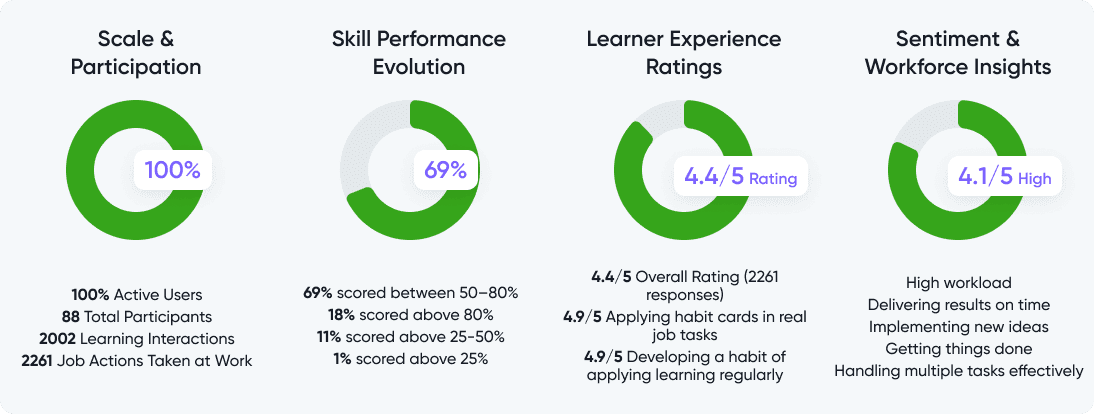
Over time, the program began influencing how employees approached operational challenges and decision-making across teams.
Employees began applying structured frameworks to analyze problems and identify root causes
Problem-solving approaches became more systematic across teams
Managers gained better visibility into how employees were applying analytical thinking in real work scenarios
Recurring operational challenges were addressed through more structured analysis
Learning became embedded within daily workflows rather than remaining limited to training sessions
Area | Before Eubrics | With Eubrics AI |
Problem-Solving Approach | Ad-hoc problem handling | Structured analytical frameworks |
Workplace Application | Limited learning transfer | 2261 job actions applied |
Employee Engagement | Traditional training participation | 100% completion rate |
Operational Visibility | Informal feedback | Real-time sentiment insights |
Learning Adoption | Episodic training | Continuous learning habits |
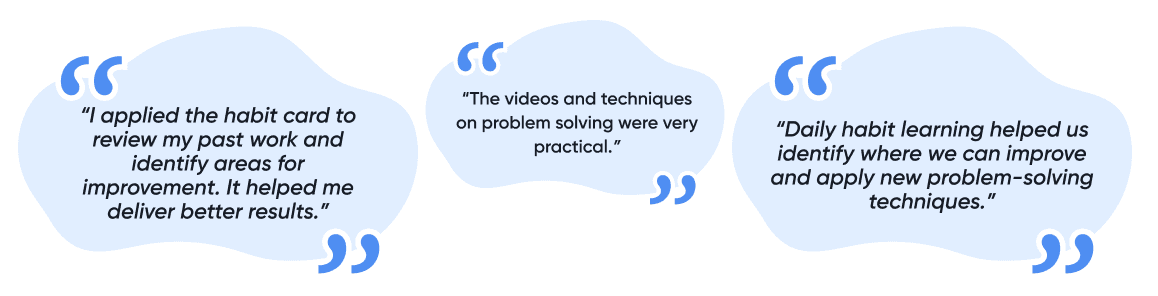
This initiative demonstrates how organizations can strengthen analytical problem-solving capabilities by introducing structured learning journeys supported by habit-based application and measurable engagement insights. By shifting from traditional training sessions to continuous workplace learning, the manufacturing enterprise established a scalable framework that enables employees to apply analytical thinking, improve operational outcomes, and sustain long-term capability development.